Skip to content

Our vision is a highly delicate and sophisticated sensory framework, relying on the perfect clarity of internal ocular structures to process the world around us. Because we depend so heavily on an unblemished visual field, noticing sudden anomalies can be a highly startling and anxiety-inducing experience. Among the most common visual disturbances reported by patients are floaters in eyes. These drifting specks, threads, or cobwebs can appear out of nowhere, tracking your eye movements and darting away whenever you attempt to look at them directly.
At WellDemir, we prioritize patient education alongside cutting-edge clinical care. Ocular health requires a balanced approach that distinguishes between harmless, age-related tissue evolution and acute ophthalmic emergencies.
As diagnostic technology in 2026 allows for unprecedented visualization of the inner eye, identifying the exact reason for floaters in eyes has become a highly streamlined and precise medical science, giving patients the tools they need to protect their long-term sight with confidence.
Get Free Consultation
Have any questions? Leave your details and we'll get back to you shortly.
Table of Contents
What Are Eye Floaters? Deciphering the Shapes in Your Vision
To manage these disturbances effectively, it is essential to first understand what are floaters in the eye from an anatomical perspective. Many patients mistakenly believe that these spots are sitting on the outer surface of the cornea or are caused by dust particles floating in the air.
In reality, when you are seeing floaters in eyes, you are looking at the shadows of internal microscopic debris. The back chamber of the eye is filled with a transparent, jelly-like matrix called the vitreous humor. As we move through life, this gel gradually loses its thick consistency.
When the vitreous shrinks, its delicate network of collagen fibers begins to break apart and clump together. These microscopic strands drift freely within the newly liquefied pockets of the eye, intercepting incoming light and casting shadows directly onto the retina—the light-sensitive tissue at the back of the eye. These shadows are what manifest in your visual field as black floaters in eyes, thin translucent webs, or drifting gray rings.
What Causes Floaters in Eyes to Form?
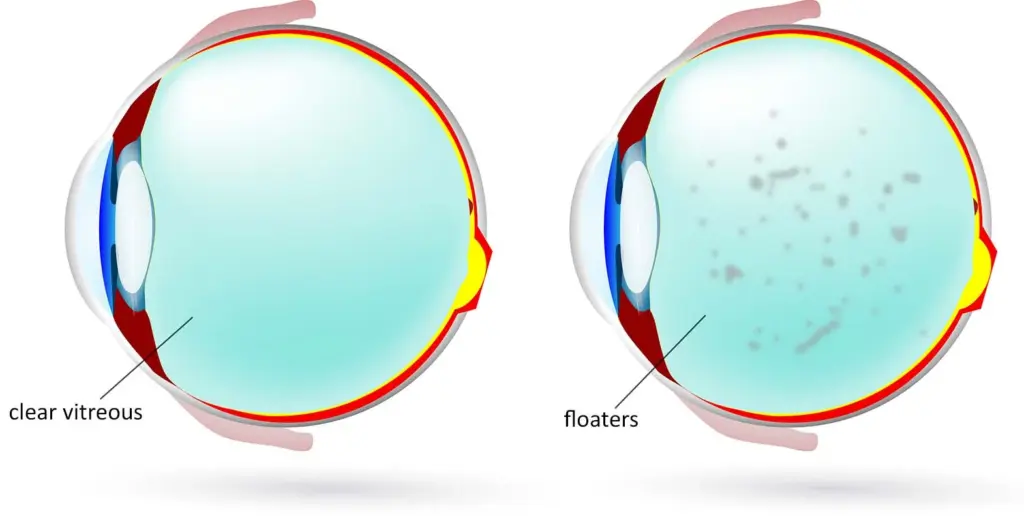
When looking at the clinical origins of these visual spots, understanding what causes floaters in the eye requires an analysis of both natural biological progression and external physical influences. The eye is a dynamic organ, and its internal environment is subject to shifts over time.
- The Natural Aging Process: This is the primary floaters in eyes causes category. The structural degradation of the vitreous matrix is a normal aspect of growing older, typically starting to show noticeable progress after the age of 50.
- High Myopia (Nearsightedness): Individuals with severe nearsightedness possess eyeballs that are slightly longer from front to back than average. This elongation places continuous structural stretch on the internal ocular tissues, often causing black floaters in eye formations to develop at a much younger age.
- Intraocular Inflammation (Uveitis): Certain inflammatory conditions affecting the structures inside the eye can cause a release of cellular debris into the vitreous gel, resulting in dense, cluster-like floaters.
- Ocular Trauma: A direct physical impact or injury to the face can disrupt the vitreous framework, shaking loose microscopic collagen fibers or causing micro-bleeding that presents as sudden spots in your vision.
The Evolving Vitreous: Understanding Posterior Vitreous Detachment
The most common specific developmental milestone responsible for a sudden increase in visual debris is a process known as vitreous detachment, or more specifically, Posterior Vitreous Detachment (PVD). This is a widespread condition where the shrinking vitreous gel completely separates itself from its connection points on the surface of the retina.
During youth, the vitreous gel is firmly attached to the retinal framework. As liquefaction progresses, the gel naturally pulls away from the back of the eye. While PVD is a non-disease process that occurs safely in millions of people, the physical act of separation can leave behind a noticeable, large, ring-shaped floater called a Weiss Ring.
However, because the vitreous is tugging on the retina as it detaches, this phase requires careful monitoring by an ophthalmologist to ensure the underlying light-sensitive tissue is not damaged during the separation.
When to Worry: Distinguishing Harmless Floaters from Retinal Emergencies
While the vast majority of drifting spots are benign consequences of aging tissues, they can occasionally act as an early warning sign for a condition that threatens your sight. Learning when a spot is safe and when it represents a serious medical issue is vital for protecting your vision.
If you develop a sudden floaters in one eye episode, it is a clear indicator that your internal ocular environment is undergoing a rapid transition. This shift demands a professional look beneath the surface, as waiting for the symptoms to improve on their own can lead to permanent structural complications.
Red Flag 1: A Sudden Influx of New Floaters
An occasional, slow-moving thread that you have noticed for months is rarely a cause for concern. However, if you suddenly experience a massive cloud of new black floaters in eye shapes it indicates that a significant structural event has occurred inside the eye, such as a ruptured micro-vessel or a tissue tear.
Red Flag 2: Accompanying Flashes of Light
The retina does not possess pain receptors; instead, it communicates physical stress through visual signals. When the vitreous gel pulls too hard on the retinal tissue, the brain interprets this mechanical traction as flashes of light, similar to lightning streaks or static sparks in your peripheral vision. Seeing these flashes alongside new floaters is a prominent indicator of active structural pull on the back of your eye.
Red Flag 3: The “Dark Curtain” Effect (Vision Loss)
If a retinal tear symptoms progression is left unaddressed, fluid from the liquefied vitreous can seep through the tear, peeling the retina away from its underlying blood supply like wallpaper coming off a damp wall. This process, known as retinal detachment, creates a dark, non-seeing curtain or shadow that slowly moves across your field of vision from the top, bottom, or sides. This is an absolute ophthalmic emergency that requires immediate surgical intervention to avoid permanent blindness.
Modern Treatment Options for Chronic Floaters
For patients dealing with stable, non-emergency floaters that are simply large enough to disrupt reading, driving, or professional focus, modern ophthalmology offers several clinical pathways. The choice of an appropriate remedy for floaters in eyes depends heavily on how severely the debris impacts your quality of life.
1. Observation and Visual Adaptation (The Wait-and-See Approach)
For the vast majority of cases, the safest and most recommended pathway is simple observation. When patients ask, “will floaters in eye go away?” the anatomical answer is that the physical clumps rarely disappear completely.
However, over a period of six to twelve months, gravity naturally causes the debris to settle down toward the bottom of the eye chamber, away from your direct line of sight. Simultaneously, the brain undergoes a process called neuroadaptation, learning to actively filter out the static shadows so that you stop noticing them during daily activities.
2. Laser Vitreolysis (YAG Laser Therapy)
For patients with large, dense, centrally located floaters that severely block vision, a non-invasive procedural option called Laser vitreolysis is available. This technique utilizes a specialized, highly focused YAG laser to deliver rapid bursts of energy directly to the floaters.
The laser light converts the solid collagen clumps into small gas bubbles, effectively vaporizing them or breaking them into microscopic pieces that are too small to cast a noticeable shadow on the retina. This outpatient procedure requires no incisions and allows for a rapid return to daily routines.
3. Pars Plana Vitrectomy (Surgical Removal)
In rare, debilitating cases where a patient’s vision is severely compromised by a dense cloud of floaters that laser therapy cannot safely resolve, a surgical procedure known as a Pars Plana Vitrectomy can be considered.
During this microscopic surgery, an ophthalmic surgeon makes tiny incisions in the white part of the eye (sclera) to carefully remove the entire vitreous gel along with all its floating debris. The chamber is then filled with a crystal-clear, biocompatible saline solution that seamlessly substitutes for the natural gel, permanently clearing the visual path.
Laser and Surgical Floater Treatments in Turkey 2026
Istanbul has positioned itself as a primary global hub for advanced medical and ophthalmic specialties. Seeking care through WellDemir allows international patients to access top-tier diagnostic, laser, and surgical eye care under highly structured and affordable conditions.
Ophthalmic centers in Turkey utilize the latest 2026 diagnostic suites, including high-resolution Optical Coherence Tomography (OCT) and widefield fundus photography, ensuring that every layer of your retina is evaluated with absolute precision before any treatment is initiated. By integrating luxury accommodation, seamless VIP transfers, and bilingual medical support, traveling for advanced eye care is transformed into a smooth, stress-free experience that prioritizes your visual well-being at every step.
Protecting Your Vision: Everyday Habits for Vitreous Health

While you cannot completely halt the natural aging of your eye tissues, incorporating specific habits into your lifestyle can support overall ocular health and make managing visual changes much easier. If you are researching how can i get rid offloaters in the eye or searching for ways how to reduce floaters in eyes naturally, focusing on preventative care is the most sound medical approach.
- Maintain Optimal Hydration: The vitreous gel is composed of roughly 98% water. Chronic dehydration can alter the delicate fluid balance inside the eye, potentially accelerating the shrinkage and clumping of the internal collagen matrix.
- Wear UV-Protective Eyewear: Exposure to intense ultraviolet light can accelerate oxidative stress within the ocular fluids, damaging the clear proteins of the lens and vitreous. Wearing polarized sunglasses outdoors is a fundamental step in long-term protection.
- Schedule Regular Dilated Eye Exams: The absolute best way to manage floaters is through regular preventative mapping. A dilated exam allows an eye specialist to look at the far edges of your retina, catching and treating microscopic tears long before they turn into major visual emergencies.
FAQ: Frequently Asked Questions
Do eye floaters ever go away on their own?
The physical clumps of collagen rarely disappear entirely from the eye chamber. However, over several months, they naturally drift downward out of your direct line of sight, and your brain adjusts to filter out the shadows, making them much less noticeable.
Is there a way to dissolve eye floaters naturally?
No scientific or clinical evidence supports that lifestyle changes, eye drops, or dietary supplements can safely dissolve or clear out collagen clumps inside the vitreous matrix. Proper medical interventions are the only verified methods for clearing dense debris.
Is laser treatment for eye floaters painful?
No, laser vitreolysis is an outpatient procedure performed using localized numbing eye drops. Patients typically do not feel any sharp discomfort, experiencing only a slight sensation of pressure or seeing brief flashes of light as the laser breaks up the debris.
Why are eye floaters more visible when looking at a blue sky or a white wall?
Bright, uniform, and light-colored backgrounds cause your pupils to constrict, which sharpens the incoming light path. This specific lighting condition casts a much more distinct, high-contrast shadow of the vitreous clumps directly onto the surface of your retina.
Can dietary changes or supplements cure eye floaters?
While a diet rich in antioxidants, vitamins, and proper hydration supports general macular and retinal health, it cannot reverse the physical liquefaction of the vitreous gel or remove clumps that have already formed within the eye structure.

 |
|