Skip to content
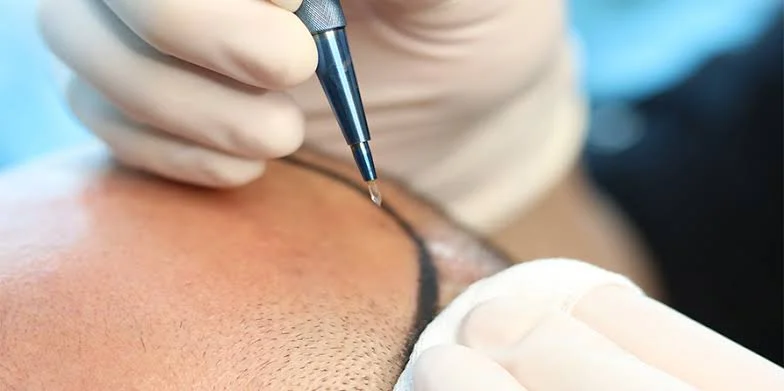
Hair restoration surgery has evolved rapidly over the past two decades. While traditional Follicular Unit Extraction (FUE) relied on surgical steel blades to create recipient channels, modern trichology increasingly utilizes synthetic sapphire gemstone blades. This refined surgical protocol is known internationally as a sapphire FUE hair transplant.
Understanding how gemstone blades impact graft survival, tissue trauma, and density is essential for prospective patients. Individuals frequently ask what is sapphire FUE, evaluate the advantages of micro sapphire FUE, compare sapphire FUE vs dhi, analyze the difference between sapphire FUE and dhi, research sapphire FUE turkey clinic packages, assess the sapphire FUE recovery timeline, and check whether sapphire FUE scars are visible. This clinical guide provides an in-depth breakdown of the Sapphire FUE technique, procedural steps, recovery milestones, and comparative advantages.
Table of Contents
What Is Sapphire FUE and How Does It Work?
If you are wondering what is sapphire FUE, it is an advanced variation of the standard FUE method where recipient channel incisions are made using ultra-sharp blades crafted from synthetic sapphire (corundum crystal, Al2O3) rather than conventional stainless steel.
Get Free Consultation
Have any questions? Leave your details and we'll get back to you shortly.
Synthetic sapphire produces exceptionally smooth, durable, and V-shaped microscopic edges ranging from 0.8 mm to 1.5 mm in width.
BLADE MATERIAL MECHANICAL DIFFERENCES:
- [Classic Steel Blade]: U-shaped cut | Wider tissue tear | Higher bleeding | Requires larger spacing
- [Sapphire Blade]: V-shaped cut | Micro-incision | Minimal trauma | Allows high-density placement
During channel creation, the V-shaped sapphire tip creates clean micro-incisions matching the exact diameter of the harvested follicular units. Because the blade glides through the skin without tearing epidermal tissue, surgeons achieve closer graft proximity, resulting in natural density without compromising blood circulation.
Step-by-Step Breakdown: The Sapphire FUE Procedure
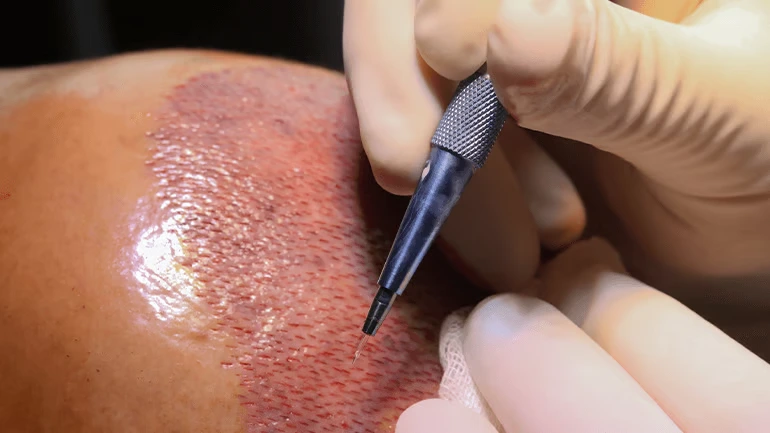
Undergoing a sapphire FUE hair transplant Turkey involves a structured four-stage clinical protocol:
1. Donor Area Preparation and Local Anesthesia
The patient’s donor area (the permanent zone at the back and sides of the scalp) is trimmed. Needle-free comfort anesthesia or standard local anesthesia is administered to ensure a completely pain-free procedure.
2. Micro-Motor Follicular Extraction
Using microscopic titanium punches (0.6 mm to 0.8 mm in diameter), individual follicular units containing 1 to 4 hair follicles are gently loosened and extracted. The harvested grafts are sorted by hair count and stored in a chilled, nutrient-rich holding solution (such as HypoThermosol or sterile saline) to maintain graft vitality.
3. Precision Sapphire Channel Opening
The surgeon determines the natural hair growth angle, depth, and distribution across the recipient area. Using customized sapphire gemstone blades, thousands of V-shaped micro-channels are opened at precise 40- to 45-degree angles.
4. Direct Manual Implantation
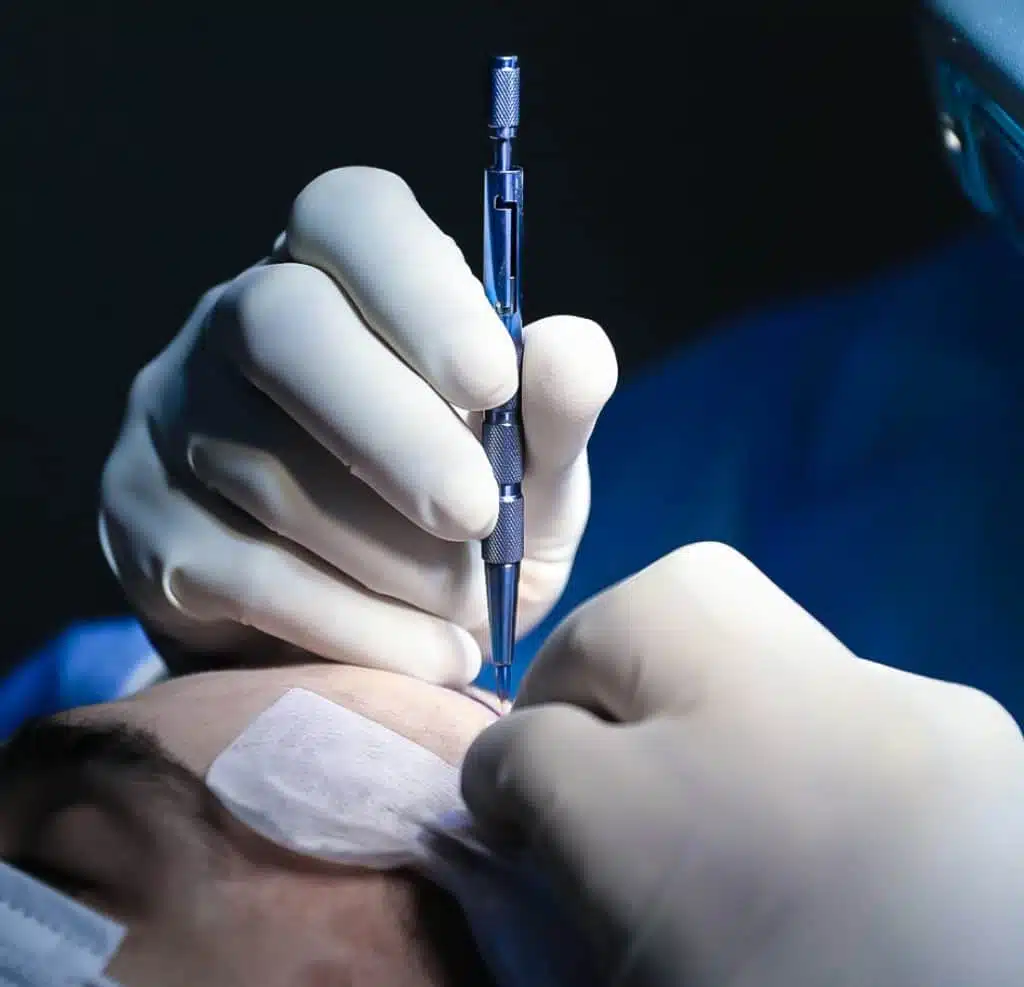
Using fine micro-forceps, surgical technicians carefully insert each harvested graft into the prepared sapphire micro-channels. The tight fit of the V-shaped incision holds the follicle securely in place, preventing graft displacement or dislodgement.
Sapphire FUE vs. DHI: Key Differences Explained
When researching modern hair restoration, patients often weigh sapphire FUE vs dhi (Direct Hair Implantation using a Choi Implanter Pen). Understanding the difference between sapphire FUE and dhi helps clarify which approach suits your hair loss pattern:
COMPARATIVE TECHNIQUE HIGHLIGHTS:
- [Sapphire FUE]: Best for large recipient areas (3,500 to 5,000+ grafts) | Channels opened prior to placement
- [DHI Technique]: Best for unshaven areas & targeted densification | Channel opening & placement simultaneous
- Graft Capacity: Sapphire FUE is ideal for higher graft counts (3,500 to 5,500+ grafts in a single session), making it suitable for extensive balding (Norwood scale 3 to 6). DHI is typically capped around 2,500 to 3,500 grafts per session due to the precision loading time of the Choi pen.
- Implantation Method: In Sapphire FUE, channel creation and graft insertion are two distinct sequential phases. In DHI, channel creation and implantation happen simultaneously in a single step using the Choi pen.
- Shaving Requirements: Sapphire FUE generally requires shaving the entire scalp to open dense micro-channels accurately. DHI can be performed without shaving the recipient area, which is popular for women or individuals maintaining long hair.
Scarring and Healing: Do Sapphire FUE Scars Exist?
One of the greatest concerns for patients is whether sapphire FUE scars will be visible on the scalp:
- Recipient Area: Because the sapphire blade creates clean V-shaped micro-punctures rather than rough U-shaped cuts, the incision borders align smoothly without skin bunching. Once scabs shed within 10 to 12 days, the recipient area heals without visible linear or dot scarring.
- Donor Area: Using sub-millimeter micro-motor punches leaves microscopic circular extraction marks smaller than 0.8 mm. Once healed, these tiny extraction dots are completely hidden beneath short hair (grade 1 or 2 haircut), eliminating the linear strip scar associated with traditional FUT surgery.
Recovery Milestones: Sapphire FUE Recovery Timeline
The micro sapphire FUE method reduces tissue trauma, resulting in a predictable sapphire FUE recovery process:
- Days 1 to 3 (Immediate Post-Op): Mild redness, minor swelling on the forehead, and tiny micro-scabs form around each graft. Antibiotics, anti-inflammatory medications, and sterile saline spray protect the scalp.
- Days 8 to 12 (Scab Removal): Daily gentle washes with clinic-provided foam soften the crusts. By day 10 to 12, all scabs naturally wash away, leaving a clean, pinkish scalp.
- Weeks 3 to 8 (Shock Loss Phase): The transplanted hair shafts temporarily shed (telogen effluvium). This is a normal biological response; the underlying follicular root remains anchored beneath the skin.
- Months 3 to 6 (Early Regrowth): Fine, new hair shafts begin pushing through the scalp, gradually thickening month by month.
- Months 9 to 12 (Final Result): Density, thickness, and natural hairline integration reach maturity. Full crown results may take up to 15 to 18 months due to slower vertex vascularity.
Comprehensive Hair Restoration Comparison Matrix
| Clinical Parameter | Sapphire FUE Hair Transplant | Direct Hair Implantation (DHI) | Classic Steel Blade FUE |
| Blade / Tool Type | Synthetic Sapphire Gemstone | Choi Implanter Pen Needle | Stainless Steel Surgical Slit |
| Incision Profile | V-shaped micro-channel | Simultaneous needle puncture | U-shaped surgical cut |
| Max Grafts per Session | 4,000 to 5,500+ Grafts | 2,500 to 3,500 Grafts | 3,000 to 4,500 Grafts |
| Tissue Trauma & Scabbing | Minimal tissue resistance | Very low tissue trauma | Moderate tissue trauma |
| Unshaven Recipient Option | Rarely (Full shave standard) | Yes (Unshaven option available) | Rarely |
| Ideal For | High-volume baldness (Norwood 3–6) | Hairline lowering & density gaps | Standard hair restoration |
| Scab Shedding Period | 8 to 10 Days | 7 to 9 Days | 10 to 14 Days |
Frequently Asked Questions (FAQ)
What makes sapphire blades better than classic steel blades in hair transplants?
Sapphire blades have a smooth, hard surface that retains its sharpness throughout the entire operation without dulling. Their V-shaped profile creates smaller micro-incisions that match the natural size of the graft, resulting in less bleeding, minimal scab formation, faster tissue healing, and higher possible graft density.
Is a sapphire FUE hair transplant painful?
No. The procedure is performed under local anesthesia. Clinics often use needle-free pressure injection devices to administer initial numbing, reducing needle discomfort by up to 70 percent. Once the area is anesthetized, patients feel only mild vibrations or pressure during extraction and channel opening.
Can sapphire FUE be used for beard and eyebrow transplants?
Yes. Because sapphire blades allow surgeons to control the angle (as low as 15 to 20 degrees) and direction of each micro-channel, they are ideal for delicate areas like beards, moustaches, and eyebrows where hair must lie flat against the skin.
When can I return to work after a sapphire FUE procedure?
Most patients working desk or remote jobs return to work within 3 to 5 days. If your job involves heavy physical labor, helmet wear, or active sweating, you should plan for 10 to 14 days of rest until the scabs have completely shed and the grafts are permanently anchored.

 |
|