Skip to content

If you find yourself instinctively holding a restaurant menu at arm’s length just to read the text, or if concentrated close-up tasks consistently leave you with a dull headache, the root cause is frequently hypermetropia. Commonly known in everyday language as long-sightedness, this refractive error changes the way light enters the eye and alters how visual stimuli are processed.
In our clinical practice, we regularly observe that patients confuse this refractive anomaly with other age-related changes in vision. Below, we explain precisely what hypermetropia means on an anatomical level, which symptoms are typical, and which medical pathways are open to you today to restore sharp, strain-free vision.
Table of Contents
What is Hypermetropia?
Hypermetropia is a widespread refractive error of the eye in which distant objects are usually perceived clearly, while nearby objects appear blurry or hazy. If a so-called bilateral hypermetropia is diagnosed, this simply means that both eyes are affected by this long-sightedness.
Get Free Consultation
Have any questions? Leave your details and we'll get back to you shortly.
In a normal-sighted eye, the cornea and the natural crystalline lens work together to bend incoming light rays exactly onto the retina where visual stimuli are converted into nerve signals. In a long-sighted eye, however, the light rays mathematically meet at a theoretical point behind the retina. The result is an unsharp image on the retinal surface whenever an object in the near range is focused.
What Are the Causes of Hypermetropia?
What Are the Causes of Hypermetropia?
The biological reasons for the development of long-sightedness lie almost exclusively in the physical proportions of the eyeball itself. In ophthalmology, we distinguish between two primary anatomical causes of hypermetropia:
- An Eyeball That is Too Short (Axial Hypermetropia): This is by far the most common form. The distance from the front of the cornea to the retina is too short in relation to the refractive power of the lens and cornea. Therefore, the light is not focused in time.
- A Too Flat Corneal Curvature (Refractive Hypermetropia): In this case, the length of the eyeball is normal, but the cornea or the lens exhibits insufficient curvature. As a result, the optical apparatus lacks the necessary refractive power to bend the light steeply enough.
Genetic factors play a decisive role in these anatomical conditions. If a pronounced long-sightedness exists in your family, the probability is statistically significantly increased that you will inherit a similar eye structure.
Hypermetropia vs. Myopia: The Structural Comparison
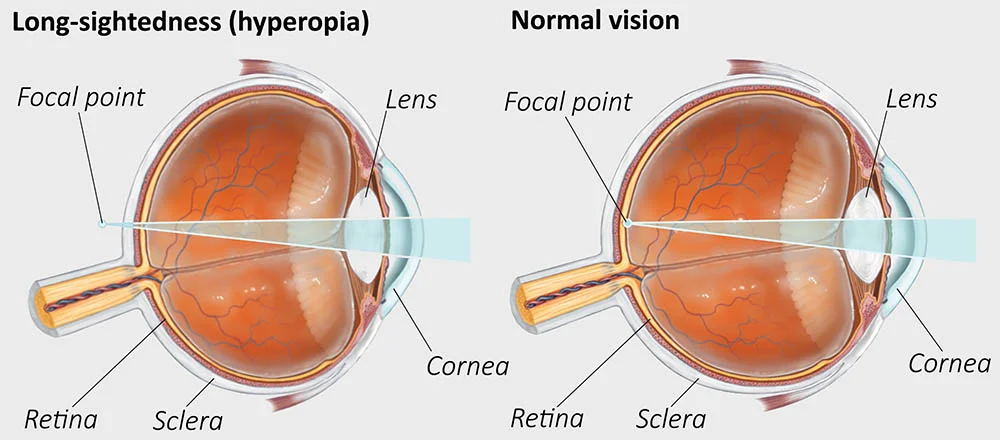
To better understand the mechanisms of long-sightedness, it helps to make a direct comparison with its counterpart, myopia (near-sightedness). Both conditions are not eye diseases in the classical sense, but rather structural variants of the eyeball that produce completely opposite focal points.
| Characteristic | Hypermetropia (Long-Sightedness) | Myopia (Near-Sightedness) |
| Primary Symptom | Near range is blurry, distance is mostly clear. | Near range is clear, distance is blurry. |
| Focal Point of Light Rays | Lies theoretically behind the retina. | Lies in front of the retina. |
| Anatomy of the Eye | Eyeball is too short or the cornea is too flat. | Eyeball is too long or the cornea is too steep. |
| Required Lens Type | Correction via convex lenses (plus lenses). | Correction via concave lenses (minus lenses). |
Symptoms and Daily Challenges
The effects of uncorrected hypermetropia are by no means limited only to a blurry typeface. Depending on the severity of the refractive error and the age of the person affected, the permanent compensatory work of the eye leads to a characteristic complex of complaints:
- Asthenopic Complaints and Eye Fatigue: To compensate for the lack of refractive power, the ciliary muscle inside the eye must constantly contract. This process (accommodation) runs unconsciously and means that long-sighted eyes are under permanent muscle tension, even when looking into the distance and especially at close range.
- Recurrent Headaches: The uninterrupted overexertion of the eye muscle frequently triggers dull, pressing headaches. These are mostly localized around the forehead or above the eyebrows and occur increasingly after long periods of reading or computer work.
- Burning or Reddened Eyes: Patients often report a feeling of dryness, a pulling sensation in the eye, or reddened conjunctiva after intensive close-up work, as the normal blinking rate decreases during extreme concentration.
- Impaired Depth Perception: If a bilateral hypermetropia is unevenly severe in both eyes (anisometropia), the brain can only fuse the two differently sharp images with difficulty, which impairs depth perception.
Does Hypermetropia Improve with Age?
One of the most frequently asked questions in our consultations is whether long-sightedness can regulate itself over the course of life. The medical answer differentiates very precisely between life phases.
Many newborns and young children exhibit a mild hypermetropia because their eyeballs are not yet fully grown. In the course of natural body growth, the eyeball usually lengthens proportionally, so that the long-sightedness completely resolves in many cases by the end of puberty.
For adults, however, hypermetropia does not improve with increasing age. On the contrary: from the age of 40, presbyopia (age-related long-sightedness) additionally makes itself felt. In this process, the body’s own lens loses its natural elasticity. A long-sighted eye that could still dismiss a mild hypermetropia in younger years through muscle power (accommodation) now loses this ability completely. Near vision often drops noticeably as a result.
Can Hypermetropia Be Cured Naturally?
There are no scientific proofs or clinical studies that demonstrate that targeted eye training, special diets, or herbal preparations can lengthen the axial length of the eyeball or permanently change the corneal curvature. Therefore, hypermetropia cannot be cured in a natural way.
While a diet rich in vital nutrients supports the general health of the retina and the tear film, a purely mechanical geometric error of the eye always requires an optical or surgical modification of the light path to be permanently resolved.
How Can Hypermetropia Be Corrected?
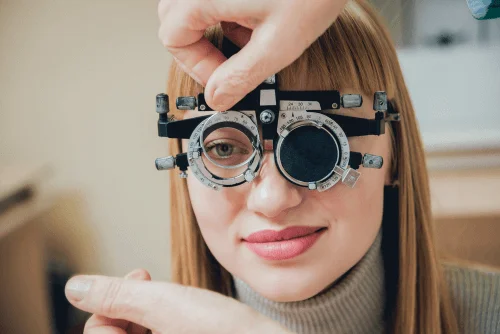
Modern ophthalmology offers highly developed, safe, and minimally invasive procedures to effectively compensate for hypermetropia. Depending on individual anatomy, age, and lifestyle of the patient, three main categories are available:
1. Conservative Correction: Glasses and Contact Lenses
The classic and risk-free method. Here, convex lenses (converging lenses with plus values) are used. These lenses are thicker in the middle than at the edge. They bend the incoming light rays slightly inward before they reach the eye. This shifts the overall focal point forward so that the image lands exactly on the retina.
2. Refractive Laser Surgery
For patients who strive for a life independent of visual aids, corneal surgery offers highly efficient options.
- LASIK or Femto-LASIK: An ultra-short laser pulse prepares a thin corneal flap. Subsequently, an excimer laser ablates tissue in the outer areas of the cornea, causing the center of the cornea to become more steeply curved. This increased curvature permanently increases the refractive power of the eye.
- PRK / Trans-PRK: This surface procedure is applied when the cornea is too thin for a LASIK. The modeling takes place directly on the outer layer of the cornea.
3. Intraocular Lens Procedures (Lens Exchange)
In the case of very high diopter values or when an advanced age-related long-sightedness is already present, lens implants are the most stable solution.
- Refractive Lens Exchange (RLE): The body’s own lens, which has become inflexible, is replaced in a short, outpatient procedure with a high-precision multifocal lens or an extended depth of focus lens (EDOF). This procedure corresponds to the principle of the proven cataract surgery and corrects the hypermetropia permanently, while simultaneously ruling out future cataracts.
Frequently Asked Questions (FAQ)
What is the main cause of hypermetropia?
The primary cause is a genetically determined, too short construction of the eyeball (axial hypermetropia) or a too small curvature of the cornea. Both factors lead to the optical focal point lying behind the retina.
Can a long-sightedness be completely eliminated surgically and permanently?
Yes. Through modern refractive interventions such as Femto-LASIK or refractive lens exchange (RLE), the refractive power of the eye can be adjusted so precisely that the hypermetropia is permanently compensated and the dependence on glasses is eliminated.
Why does one often notice a mild hypermetropia only with age?
Young people possess an extremely flexible crystalline lens. They can unconsciously compensate for a mild long-sightedness by tensing the eye muscle (accommodation). If this elasticity decreases from age 40, muscle power is no longer sufficient and the refractive error suddenly becomes symptomatic.
What risks exist if hypermetropia is not treated in children?
If a severely pronounced, bilateral or unequal hypermetropia remains undetected in childhood, the visual center in the brain does not learn to process sharp images. This can lead to a permanent visual weakness (amblyopia/lazy eye) that can no longer be corrected in adulthood.
Does reading in poor light damage the eyes of long-sighted people?
No, poor light does not change the organic structure or length of the eyeball and thus does not permanently worsen hypermetropia. However, it does lead to a massive short-term overexertion of the eye muscles and accelerates the occurrence of headaches.

 |
|