Skip to content

Rhinoplasty is widely recognized as one of the most technically demanding operations in aesthetic and reconstructive plastic surgery. Because the nasal architecture consists of delicate bone, flexible cartilages, mucosal linings, and an overlying skin envelope, even millimeter-level discrepancies can alter both facial harmony and respiratory airflow. When a primary surgery yields suboptimal aesthetic contours, structural collapse, or functional nasal obstruction, patients turn to secondary corrective intervention: a revision rhinoplasty.
Undergoing a second procedure requires thorough clinical research and emotional readiness. Prospective patients often ask what is revision rhinoplasty, evaluate critical waiting timelines asking how long to wait for revision rhinoplasty, review documented revision rhinoplasty before and after transformations, assess the complex challenges and risks of revision rhinoplasty, explore specialized international programs for revision rhinoplasty Turkey, and examine the variables that determine the overall revision rhinoplasty Turkey cost. This medical guide examines surgical principles, structural grafting methods, recovery milestones, and procedural pricing dynamics.
Table of Contents
What Is Revision Rhinoplasty and Why Is It Performed?
If you are evaluating what is revision rhinoplasty, it is a secondary, tertiary, or subsequent surgical intervention designed to correct cosmetic deformities, structural deficits, or breathing difficulties resulting from one or more prior nose surgeries.
Get Free Consultation
Have any questions? Leave your details and we'll get back to you shortly.
Unlike a primary nose job, where the nasal anatomy is untouched and native septal cartilage is abundant, a secondary operation is primarily a reconstructive procedure. The underlying issues usually fall into two main categories:
- Cosmetic Deformities: Persistent or new asymmetries, an over-resected “scooped” dorsum, an inverted-V deformity, a pinched nasal tip, retracted alar rims, a drooping columella, or uneven nostrils.
- Functional Airway Obstructions: Internal or external nasal valve collapse, recurrent septal deviation, synechiae (internal scar adhesions), or septal perforations that restrict airflow and force chronic mouth breathing.
SURGICAL COMPLEXITY HIERARCHY:
Primary Rhinoplasty (Native cartilages present, virgin tissue planes, predictable vascularity)
↓
Secondary / Revision Rhinoplasty (Scar tissue formation, depleted septum, structural grafting required)
↓
Tertiary / Complex Reconstructive Rhinoplasty (Multiple prior surgeries, compromised skin envelope, rib autografts)
Technical Challenges and Risks of Revision Rhinoplasty

The challenges and risks of revision rhinoplasty are significantly greater than those encountered during primary surgery:
1. Navigating Dense Fibrotic Scar Tissue
Prior surgical trauma triggers the formation of disorganized, fibrous scar tissue beneath the skin. This dense tissue obscures natural anatomical planes, compromises tissue elasticity, and adheres tightly to the underlying cartilage framework, making delicate tissue dissection far more difficult.
2. Depleted Native Cartilage Resources
In most primary operations, the central nasal septum is harvested to straighten the nose or construct tip grafts. In revision surgery, the surgeon frequently discovers that native septal cartilage is completely exhausted. Alternative donor cartilage sources must be harvested from the patient:
- Conchal (Ear) Cartilage: Soft and naturally curved, making it ideal for restoring alar rim contours and tip definition, though it lacks the structural rigidity needed to straighten a collapsed bridge.
- Costal (Rib) Cartilage: The gold standard for major reconstructions. Either autologous rib cartilage (harvested through a small incision under the breast crease) or irradiated cadaveric donor rib cartilage provides straight, rigid structural struts to rebuild the nasal bridge, support the tip, and open collapsed nasal valves.
3. Compromised Vascularity and Skin Envelope
Repeated surgical disruptions compromise the subdermal vascular plexus of the nasal skin. This heightens the risk of delayed skin healing, prolonged tip edema, and, in rare instances, localized skin necrosis.
Timing: How Long to Wait for Revision Rhinoplasty?
A critical question for dissatisfied patients is how long to wait for revision rhinoplasty.
The universal clinical standard requires waiting a minimum of 12 full months before undergoing revision surgery. In complex cases involving thick skin, extensive previous grafting, or multiple prior interventions, surgeons routinely recommend waiting 18 to 24 months.
WHY DELAYING REVISION SURGERY IS ESSENTIAL:
- [Months 1 to 6] -> Severe internal edema obscures bone and cartilage contours
- [Months 6 to 9] -> Dense scar tissue softens; microvascular circulation stabilizes
- [Months 12 to 18] -> Skin envelope shrinks down completely; true baseline anatomy is revealed
Operating too early on an inflamed, indurated nose significantly elevates the risk of severe scarring, poor graft integration, and repeat failure.
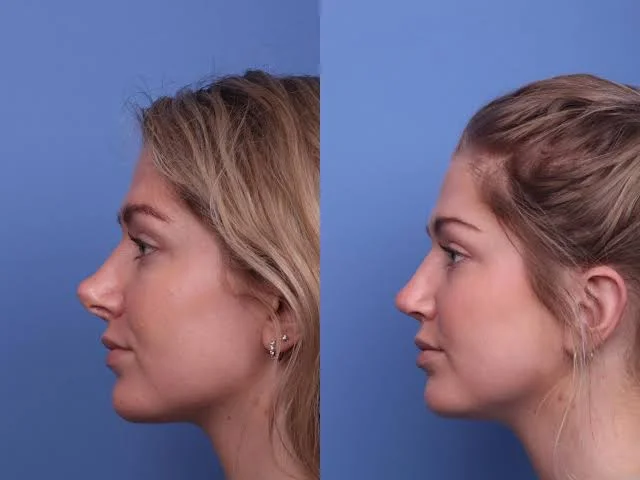
Visual Expectations: Revision Rhinoplasty Before and After
Reviewing clinical revision rhinoplasty before and after records illustrates how reconstructive surgery restores both form and function:
- Restoration of Structural Balance: An over-resected, collapsed bridge is rebuilt to a straight, strong profile using dorsal onlay grafts.
- Correction of a Pinched Tip: Pinched, collapsed lower lateral cartilages are reinforced with lateral crural strut grafts or alar batten grafts, restoring a softer, natural tip contour.
- Re-opening the Airways: Spreader grafts placed between the septum and upper lateral cartilages expand the internal nasal valve angle, providing immediate improvement in nasal airflow.
- Camouflaged Scars: Open revision procedures use the transcolumellar incision line from previous surgeries, refining the scar so it heals as a faint, imperceptible line.
Recovery Milestones and Healing Timeline
The recovery following revision rhinoplasty requires patience, as dense scar tissue prolongs the resolution of lymphatic swelling:
- Days 1 to 7: A protective thermoplastic nasal splint and internal silicone splints (doyle splints) support the reconstructed bridge and septum. Bruising around the eyes peaks around day 3 and begins to fade.
- Day 7 to 10: External splints, tape, and non-dissolvable columellar skin sutures are removed in the clinic. Initial results are visible, though the nose remains swollen.
- Weeks 2 to 4: Roughly 60 to 70 percent of visible bruising and acute swelling resolves. Most patients can return to social outings and non-strenuous desk work.
- Months 3 to 6: Deep swelling across the bony upper third clears. The nasal bridge sharpens, while the nasal tip remains firm and slightly indurated.
- Months 12 to 24: Subtle, residual lymphatic swelling in the nasal tip and thick skin envelope subsides completely, revealing the final refined contours.
Procedural Comparison: Primary vs. Revision Rhinoplasty
| Clinical Parameter | Primary Rhinoplasty | Secondary / Revision Rhinoplasty |
| Surgical Anatomy | Normal, unscarred tissue planes | Altered landmarks with dense fibrotic scar tissue |
| Septal Cartilage Availability | Abundant, readily available native cartilage | Depleted or fractured; donor ear/rib often required |
| Operative Time | Typically 2 to 3 hours | Typically 3 to 5+ hours (especially with rib harvest) |
| Surgical Objective | Reduction, reshaping, or refining | Reconstruction, structural support, and airway opening |
| Swelling Duration | 12 to 14 months for final resolution | 18 to 24 months due to altered lymphatic drainage |
| Technical Complexity | Moderate | High to Extreme |
What Determines the Revision Rhinoplasty Turkey Cost?
When evaluating revision rhinoplasty Turkey cost or planning treatment via revision rhinoplasty Turkey programs, prospective patients will find that pricing is personalized rather than fixed. Total treatment fees depend on several specific clinical, surgical, and logistical factors:
- Surgical Complexity and Number of Prior Procedures: Correcting a minor tip asymmetry requires less operative time and surgical instrumentation than reconstructing a severely collapsed nose that has undergone two or three previous surgeries.
- Need for Donor Cartilage Harvesting: When a patient requires autologous rib (costal) cartilage harvesting, an additional surgical site, longer general anesthesia, and specialized instruments are necessary, which increases procedural fees.
- Surgeon Expertise and International Reputation: Board-certified plastic surgeons and facial ENT specialists who dedicate their practices primarily to complex revision rhinoplasty charge professional fees that reflect their advanced skill and track record.
- Hospital Accreditation and Technology: Surgeries performed in internationally accredited (e.g., JCI-certified) hospitals with full intensive care support and advanced piezoelectric (ultrasonic) surgical platforms reflect higher facility standards.
- All-Inclusive Medical Tourism Packages: Comprehensive packages in Turkey often bundle the revision procedure, general anesthesia, hospital stay, 4- or 5-star hotel accommodation (typically 7 to 8 nights), VIP private airport-clinic transfers, specialized medications, and dedicated translation services into one structured arrangement.
Frequently Asked Questions (FAQ)
Is revision rhinoplasty more painful than primary rhinoplasty?
Most patients report that the nasal discomfort during revision rhinoplasty is comparable to, or even milder than, their primary surgery. However, if autologous rib cartilage is harvested from the chest wall, the donor site under the breast crease will feel sore and tender (similar to a bruised rib) for 7 to 10 days, requiring scheduled oral analgesics.
Can revision rhinoplasty fix both breathing issues and cosmetic problems simultaneously?
Yes. In fact, addressing both aspects together is the primary objective of modern revision rhinoplasty. Surgeons routinely harvest cartilage grafts to reconstruct the internal nasal valves, straighten deviated septal remnants, and expand narrowed airways while simultaneously sculpting a balanced external aesthetic profile.
Why is rib cartilage preferred over synthetic implants in revision rhinoplasty?
Autologous rib cartilage is living tissue harvested from the patient’s own body. Unlike synthetic implants (such as silicone or Medpor), autologous cartilage integrates into the surrounding tissue, resists infection, and has a near-zero rate of extrusion or skin breakdown over the patient’s lifetime.
What happens if I am still unhappy with my revision rhinoplasty?
Minor touch-ups (such as smoothing a tiny bony edge or shaving a small scar band) are sometimes performed in-office under local anesthesia after the nose has healed for a full year. Achieving realistic alignment during the consultation by openly discussing structural limitations prevents unmet expectations.

 |
|