Skip to content


Facial balance is governed by the aesthetic rule of thirds, dividing the face into balanced vertical segments: from the hairline to the glabella between the eyebrows, from the glabella to the base of the nose, and from the base of the nose to the bottom of the chin. When the upper third is disproportionately long due to a genetically high hairline, it can disrupt facial harmony and make the forehead appear overly broad. Unlike receding hairlines triggered by hormonal hair loss, congenital high hairlines cannot be lowered through topical hair growth serums or medications. While follicular hair grafting takes up to twelve months to show visible density, forehead reduction surgery (surgical hairline advancement) delivers an immediate, single-stage repositioning of the hairline.
Patients researching facial contouring frequently examine long-term results in forehead reduction surgery before and after portfolios, evaluate specialized international travel packages for forehead reduction surgery Turkey, assess the safety and feasibility of forehead reduction surgery men, explore specific considerations for a woman forehead reduction surgery, prepare for post-operative milestones during forehead reduction surgery recovery, ask with concern does forehead reduction surgery leave a scar, and research clinical variables that dictate the overall forehead reduction surgery cost Turkey. This clinical guide examines the anatomy, surgical methodology, recovery benchmarks, and pricing drivers.
Table of Contents
What Is Forehead Reduction Surgery and How Does It Work?
A forehead reduction surgery is a specialized facial plastic surgery procedure designed to physically lower the anterior hairline and excise redundant forehead skin in a single operation, typically advancing the scalp by one and a half to two and a half centimeters.
Get Free Consultation
Have any questions? Leave your details and we'll get back to you shortly.
The biological rationale and surgical mechanics revolve around scalp laxity:
- Pre-Operative Scalp Mobility Evaluation: The surgeon assesses the glide of the epicranial aponeurosis (galea aponeurotica) over the pericranium. Good scalp laxity allows significant forward movement without tension.
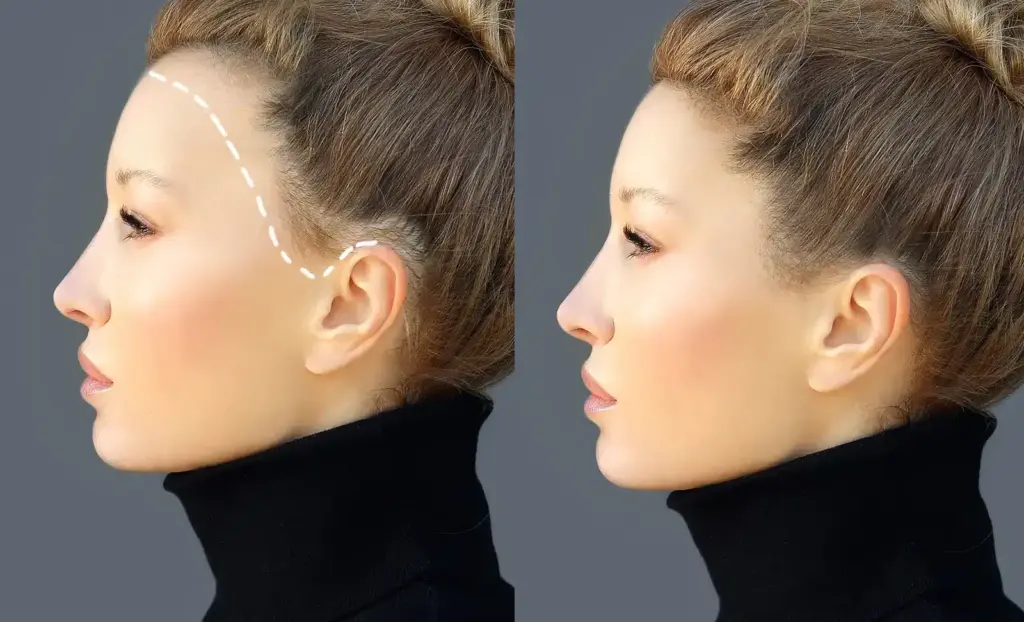
- Trichophytic Incision Geometry: Rather than cutting a straight line, the surgeon designs an irregular, wavy incision placed immediately in front of the finest hairs of the hairline. The blade is angled at forty-five degrees (trichophytic bevel) to deliberately cut through hair shafts beneath the surface. This ensures that surviving hair roots grow directly through the healing scar, camouflaging the incision line over time.
- Subgaleal Tissue Mobilization: The entire hair-bearing scalp is undermined backward toward the crown in the loose areolar tissue plane (subgaleal space). This wide mobilization frees the scalp so it can slide forward freely.
- Deep Galeal Anchoring (Endotine or Suture Fixation): To prevent tension on the skin edges and eliminate wound stretching, the deep galeal layer is anchored directly to the frontal bone using bio-absorbable Endotine clips or drill-hole bone tunnels.
- Excess Skin Excision and Layered Closure: The overlapping forehead skin is excised, and the margins are closed in multiple microscopic layers without tension.
Candidates: Woman Forehead Reduction Surgery vs. Forehead Reduction Surgery Men
Patient selection is critical to ensuring aesthetic longevity:
1. Woman Forehead Reduction Surgery
Women are the most frequent candidates for this procedure. A classic female hairline features an unbroken, rounded, or oval contour without temporal recession. Because women rarely experience androgenetic male pattern baldness, the hairline remains biologically stable behind the incision line throughout life. A woman forehead reduction surgery instantly restores youthful, feminine facial proportions.
2. Forehead Reduction Surgery Men
Suitability for forehead reduction surgery men requires strict clinical screening:
- Ideal Male Candidates: Men with a naturally high, mature hairline, strong family hair density, and zero signs of progressive genetic thinning or active male pattern baldness (Norwood stage one or stable non-progressing hairline).
- High-Risk Scenarios: If a young man undergoes surgical advancement while harboring active genetic baldness, future follicular thinning behind the incision will expose the surgical scar on the forehead. For men with receding corners (bitemporal recession), hair transplant grafting is often preferred over surgical advancement, or the two procedures are combined.
Scar Maturation: Does Forehead Reduction Surgery Leave a Scar?
A primary concern among prospective patients is does forehead reduction surgery leave a scar:
- Yes, Any Skin Incision Leaves a Permanent Mark: However, when executed using a beveled trichophytic closure, the resulting scar is designed to become practically invisible.
- Weeks One to Four (Early Healing): The wavy incision line remains pink, firm, and slightly raised. Fine external micro-sutures or surgical staples are removed at the clinic around day five to seven. Tissues behind the incision will feel numb due to temporary sensory nerve stretching.
- Months Two to Three (Hair Regrowth Phase): The transected hair follicles beneath the beveled incision begin producing new hair shafts. These baby hairs sprout directly through the scar tissue, physically obscuring the incision border.
- Months Six to Twelve (Final Camouflage): The scar line softens, flattens, and fades to a pale, silvery, pencil-thin line that blends with the natural irregularities of the front hair row.
Recovery Roadmap: Forehead Reduction Surgery Recovery
Understanding the day-to-day phases of forehead reduction surgery recovery helps patients plan their routine with confidence:
- Days One to Three (Acute Swelling and Bandaging): A supportive compression head wrap is worn to prevent fluid collection and protect the mobilized scalp. Swelling peaks around day three, occasionally drifting downward into the upper eyelids and forehead. Cold gel packs and sleeping with the head elevated on two soft pillows relieve tension.
- Days Four to Seven (Wound Care and Washing): The compression dressing is removed, and patients are guided on gently washing their hair with mild shampoo, avoiding aggressive scrubbing along the incision line. Non-absorbable skin sutures are removed.
- Weeks Two to Three (Return to Normal Life): Most patients return to non-strenuous office jobs and light social activities within ten to fourteen days. Minor residual bruising along the forehead can be concealed with mineral makeup.
- Months One to Six (Sensation Normalization): Temporary numbness at the crown of the head gradually subsides over three to six months as microscopic branches of the supraorbital and supratrochlear nerves regenerate.
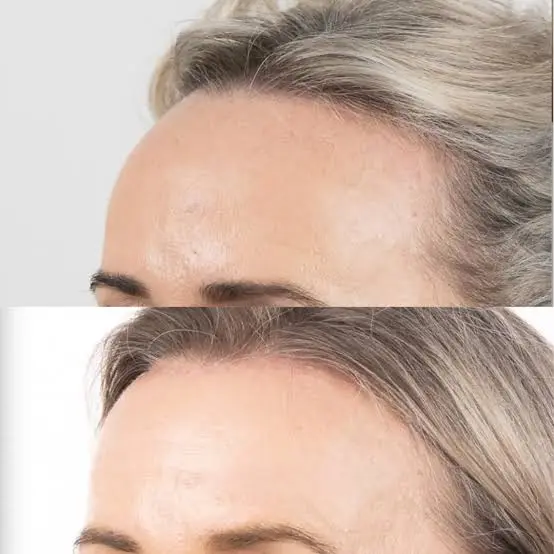
Visual Changes: Forehead Reduction Surgery Before and After
Examining clinical forehead reduction surgery before and after portfolios illustrates structural, aesthetic improvements:
- Immediate Hairline Lowering: The forehead height is shortened by one and a half to two and a half centimeters in a single surgical session, eliminating months of waiting required by hair grafting.
- Balanced Facial Thirds: The upper, middle, and lower segments of the face achieve mathematical proportion, softening an elongated facial appearance.
- Preservation of Natural Hair Density: Unlike hair transplants, which redistribute hairs and can result in sparse placement, surgical advancement shifts existing hair forward with its native, full follicle density intact.
- Enhanced Hairstyle Versatility: Patients gain the confidence to pull their hair back into high ponytails, buns, or swept-back styles without feeling self-conscious about forehead size.
Essential Post-Operative Safety Guidelines
- Wear the Post-Op Headband as Directed: Use the supportive compression band for the first week to keep the scalp tissues stabilized against the skull and minimize dead space.
- Avoid Bending and Heavy Straining: Refrain from heavy lifting (anything over five kilograms), vigorous fitness routines, and bending with your head below your heart for at least three weeks to prevent hematoma formation.
- Keep the Incision Clean and Moisturized: Apply prescribed antibiotic or healing ointments to the suture line twice daily to support scar regeneration.
- Protect the Incision from UV Rays: Keep the healing incision shielded from direct sunlight by wearing a loose, wide-brimmed hat or applying broad-spectrum mineral sunscreen after the first month to prevent hyperpigmentation of the scar.
Comparative Matrix: Surgical Forehead Reduction vs. Hair Transplant
| Clinical Parameter | Forehead Reduction Surgery (Surgical) | FUE Hair Transplant Grafting |
| Primary Mechanism | Skin excision and forward scalp glide | Individual follicular graft extraction and placement |
| Result Timeline | Immediate lowering (Day 1) | Gradual regrowth (9 to 15 months) |
| Hair Density | 100 percent natural native density | Limited by available donor grafts (30 to 50 FU/cm2) |
| Incision Placement | Along the frontal hairline | Tiny micro-punctures in donor and recipient sites |
| Type of Scar | Fine linear scar hidden in hair row | Thousands of pinpoint white scars in donor area |
| Ideal Candidate Profile | Women with high hairlines & good laxity | Men with receding corners or unpredictable baldness |
| Anesthesia Type | General anesthesia or Deep Sedation | Local anesthesia with light oral sedation |
| Number of Sessions | 1 Single surgical intervention | Often requires multiple sessions for high density |
What Determines the Forehead Reduction Surgery Cost Turkey?
When researching the forehead reduction surgery cost Turkey, prospective patients will discover that pricing varies based on individual clinical variables and surgical parameters rather than a single flat fee:
- Scalp Laxity and Surgical Scope: Patients with tight, inelastic scalps may require a staged procedure with a temporary tissue expander placed under the scalp months prior to advancement, which increases procedural time and complexity.
- Concomitant Procedures: Hairline lowering is frequently combined with an endoscopic brow lift (to elevate drooping eyebrows simultaneously), temporal lifting, facial fat grafting, or hair transplant micro-grafting to round out temporal recessions, adjusting operating room duration and clinical fees.
- Surgeon Specialization and Board Certification: Highly experienced facial plastic surgeons and craniofacial specialists with extensive expertise in subgaleal dissection reflect their technical precision and low complication rates in their fee structures.
- Hospital and Anesthesiology Standards: Procedures performed in fully accredited tertiary private hospitals with dedicated general anesthesia teams and overnight post-surgical nursing care contribute to the baseline facility expenses.
- All-Inclusive Travel Package Structure: Clinics offering surgical forehead reduction in Turkey frequently bundle pre-operative blood panels, hospital stays, surgical medications, postoperative headbands, boutique hotel accommodation for seven to ten nights, and private VIP chauffeur transfers into transparent care packages.
Frequently Asked Questions (FAQ)
How many centimeters can a forehead reduction lower my hairline?
On average, a single-stage forehead reduction can lower the hairline by one and a half to two and a half centimeters (roughly zero point six to one inch), depending on your individual scalp elasticity. If your scalp is naturally very flexible, even greater advancement can be achieved; if it is exceptionally tight, your surgeon will discuss realistic movement limits during your clinical consultation.
Will forehead reduction surgery cause my existing hair to fall out?
A small percentage of patients experience mild, temporary shock loss (telogen effluvium) immediately along the incision line during the first two to four weeks following surgery due to localized tissue inflammation. This is a temporary phenomenon; the resting follicles begin growing new, healthy hair shafts within three to four months.
Can forehead reduction surgery be combined with a brow lift?
Yes. Combining hairline lowering with an endoscopic brow lift is a common clinical pairing. Through the same trichophytic incision, the surgeon can access the brow muscles, release the orbital retaining ligaments, and elevate the eyebrows, simultaneously shortening an elongated forehead while brightening the eye area.
How soon after surgery can I dye or style my hair?
You should refrain from using harsh chemical hair dyes, bleaching agents, heat styling tools close to the roots, or keratin treatments for at least six to eight weeks post-surgery. These chemicals can irritate the healing incision line, trigger dermatitis, and disrupt newly sprouting hairs. Gentle blow-drying on a cool setting is generally safe after the first two weeks.

 |