Skip to content
For individuals dealing with advanced androgenetic alopecia or those requiring a corrective secondary procedure after a poorly executed surgery, the primary obstacle to a full restoration is often donor depletion. Traditional hair restoration relies entirely on the permanent hair roots found at the back and sides of the head (the occipital scalp). However, when this primary donor pool is thin, overharvested, or entirely exhausted, achieving a high-density look with standard methods becomes biologically impossible.
To overcome this structural limitation, modern hair restoration clinics use Body Hair Transplantation (BHT). Among all alternative donor sources, a beard to scalp hair transplant represents the most clinically reliable framework. Facial hair roots provide thick, resilient grafts that serve as excellent building blocks to restore volume, fill crown areas, and repair surgical scars. This comprehensive medical guide breaks down the science behind facial graft harvesting, examines the beard to scalp hair transplant procedure, reviews international pricing models, and explores why Turkey leads in this advanced technique.
Table of Contents
Why Use Facial Hair Roots?
To evaluate whether this advanced protocol matches your goals, we must answer a core question: what makes a beard to scalp hair transplant so successful compared to other body hair sources? The human beard is influenced heavily by androgenic hormones, meaning facial hair roots display specific biological traits that make them ideal for scalp placement:
Get Free Consultation
Have any questions? Leave your details and we'll get back to you shortly.
- Superior Thickness and Cross-Sectional Area: Beard hair shafts are significantly thicker than standard scalp hairs—often up to double the diameter. This increased thickness provides excellent visual coverage, allowing a smaller number of facial grafts to create significant volume and density when placed behind the hairline.
- Extended Anagen (Growth) Phase: Unlike chest, back, or leg hair beard hair roots stay in the active growing phase for years. This allows them to grow to significant lengths once transferred to the scalp environment.
- High Survival Rates: Because the jawline has excellent blood circulation, beard grafts are incredibly resilient. They exhibit elite clinical survival rates, often matching or exceeding 85% to 90%, which is vastly superior to body hair harvested from the torso.
What Happens During the Beard to Scalp Hair Transplant Procedure?
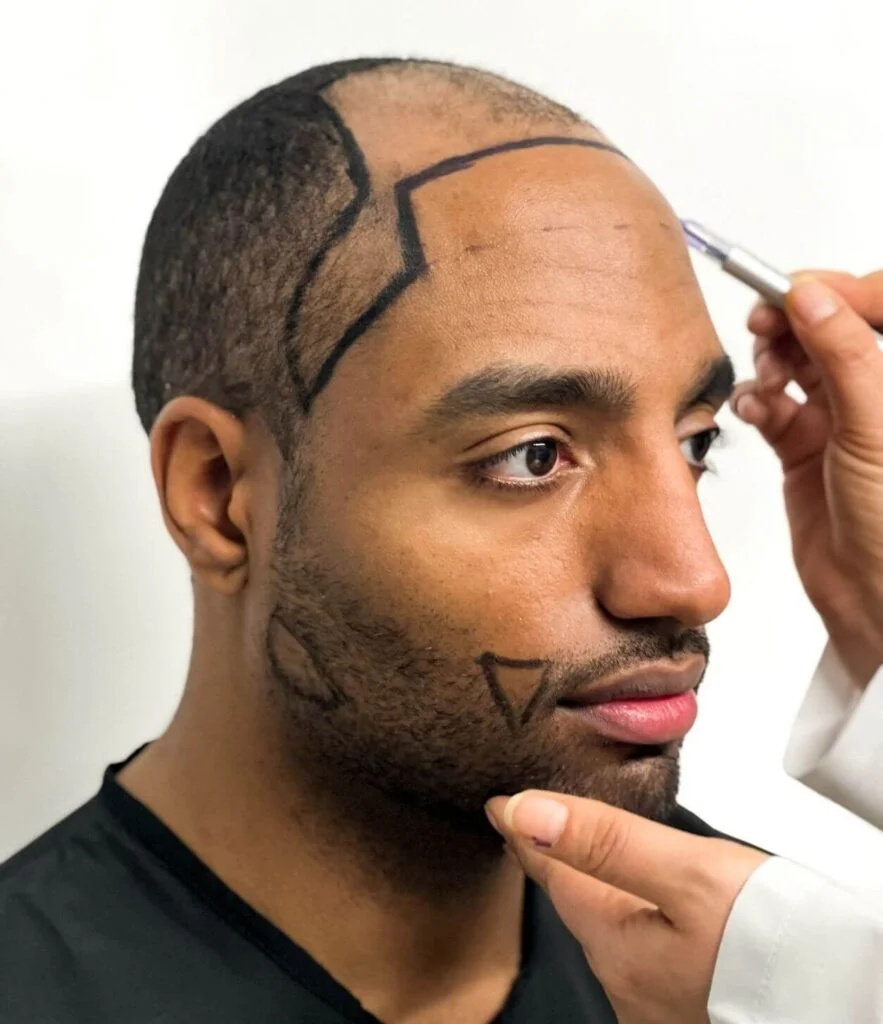
Executing this advanced technique requires extreme precision to ensure the jawline heals with zero visible scarring. A standard beard to scalp hair transplant procedure follows a structured clinical workflow:
1. Mapping and Selective Micro-Extraction
The surgeon maps out the donor grid underneath the chin and jawline. Using ultra-fine micro-punches (ranging from 0.7 mm to 0.8 mm in diameter), the grafts are extracted individually via an adapted FUE protocol. The extraction is performed in a diffuse, scattered pattern, ensuring that the remaining beard density looks completely uniform and natural.
2. Graft Preparation and Strategic Implantation
Because beard grafts are almost exclusively single-hair units, the clinical team carefully sorts and cleans them under high-magnification microscopes. These thick facial hair roots are never placed directly onto the front hairline, as their coarse texture would look unnatural at the front. Instead, they are strategically mixed with native scalp hairs and placed into the mid-scalp, vertex crown, or used to camouflage old donor scars.
How Much Does a Beard to Scalp Hair Transplant Cost Globally?
When analyzing financial parameters, the global beard to scalp hair transplant cost is generally higher than traditional scalp-only procedures. Extracting hair roots from the mobile, irregular contours of the neck and jaw requires specialized surgical expertise and takes significantly more time in the operating room.
In the United Kingdom, the United States, and Western Europe, clinics that offer advanced BHT options charge premium hourly rates, causing the total beard to scalp hair transplant cost to range between €6,000 and €14,000, depending on the number of facial grafts required. This pricing model often makes it a financially difficult choice for patients requiring multi-thousand graft corrective surgeries.
Why Is the Beard to Scalp Hair Transplant Turkey Framework Leading the Industry?
To bypass the high costs of Western clinics, choosing a beard to scalp hair transplant Turkey package has become the top choice for international patients. Turkish hair restoration centers perform thousands of advanced mega-sessions annually, giving their clinical teams unmatched experience in harvesting facial and body hair roots safely.
On average, a comprehensive beard to scalp hair transplant Turkey price ranges from €2,200 to €3,800. These all-inclusive international medical packages combine advanced FHT technology, master-surgeon expertise, luxury 5-star hotel accommodations, and private VIP airport transfers into a single, transparent solution, making high-end hair restoration accessible to everyone.
What Do the Beard to Scalp Hair Transplant Before and After Results Show?
Examining a verified beard to scalp hair transplant before and after timeline shows a powerful transformation that unfolds across several key healing phases:
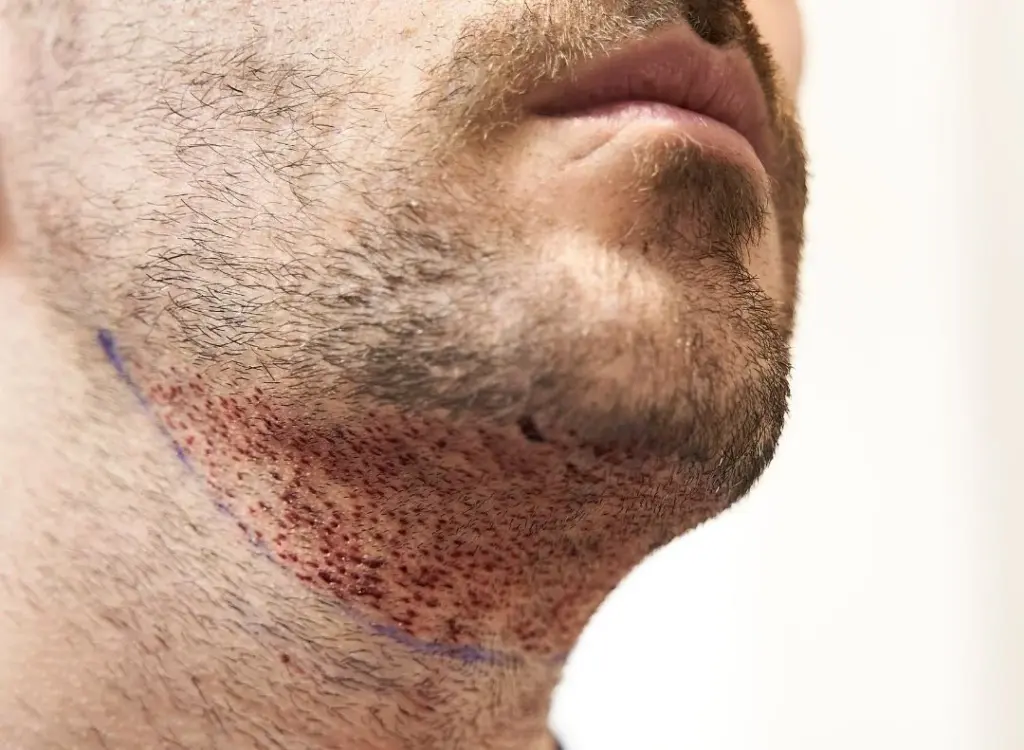
- The Donor Healing Phase (Days 1 to 7): Immediately after the procedure, the neck and jawline will show tiny red extraction dots. Because facial skin regenerates exceptionally fast, these micro-wounds close within 48 to 72 hours. By the end of the first week, the skin heals completely, leaving zero visible linear scars, allowing patients to shave or grow their beard normally.
- The Growth Phase (Months 3 to 6): The transplanted beard hair undergoes a temporary shedding phase (shock loss) before beginning its new growth cycle. Around month 4, new, thick shafts begin to sprout through the scalp surface.
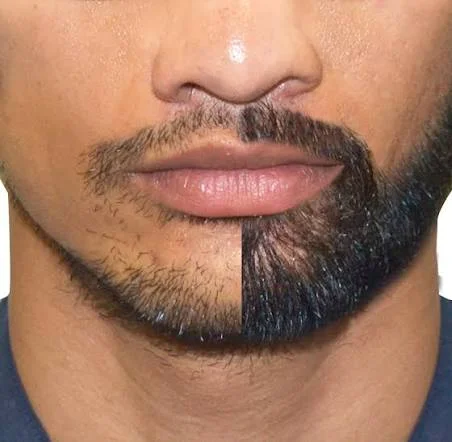
- The Ultimate Beard to Scalp Hair Transplant Result (Months 12 to 18): The final beard to scalp hair transplant result provides a dramatic increase in overall volume. The coarse, thick texture of the beard hairs creates an illusion of high density in previously barren areas, blending seamlessly with native hairs and permanently reversing advanced baldness.
Comprehensive Surgical Material
| Clinical Performance Metric | Beard Hair Roots (Facial Grafts) | Scalp Hair Roots (Occipital) | Body Hair Roots (Chest/Back) |
| Average Shaft Diameter | Ultra-Thick (Maximum Volume) | Standard / Fine | Fine / Thin (Low Volume) |
| Graft Configuration | Primarily Single-Hair Units | Multi-Hair Units (2-4 Hairs) | Exclusively Single-Hair Units |
| Extraction Punch Size | 0.7 mm to 0.8 mm (Micro) | 0.8 mm to 0.9 mm | 0.8 mm to 0.9 mm |
| Average Survival Rate | High (85% to 90%+) | Maximal (95%+) | Variable (60% to 75%) |
| Ideal Recipient Placement | Crown, Mid-Scalp, Scar Repair | Front Hairline, Full Scalp | Crown Filling Only |
| Long-Term Growth Potential | High (Adapts to scalp length) | Maximal (Natural Growth) | Limited (Stays relatively short) |
Frequently Asked Questions (FAQ)
Will extracting grafts leave visible scars or patches in my beard?
No. When performed by an experienced surgeon using a micro-punch tool below 0.8 mm, the extraction points heal as microscopic, invisible dots hidden beneath the skin tissue. Because the grafts are taken evenly from a large area under the chin and neck line, your beard will not look patchy or uneven. Once healed, you can grow your beard out or shave completely smooth without any visible tracks.
Does a beard transplant hair grow like normal hair on the head?
Yes, it undergoes a fascinating biological adaptation process called recipient co-dominance. Once the facial hair root is integrated into the scalp’s blood circulation, it slowly adapts to its new environment. While it retains its thick texture, it matches the growth speed of surrounding scalp hairs and grows significantly longer than it ever would have on the jawline.
Can facial hair be used to build a brand-new front hairline?
No, using beard hair to construct the very front rows of a hairline is a clinical mistake. Because beard shafts are very coarse, thick, and grow as single-hair units, placing them at the front would create an unnatural, pluggy look. A premier hairline requires fine, soft single-hair grafts harvested from the neck or temples. Beard grafts are reserved for adding volume behind the hairline.
How many grafts can safely be harvested from the beard area?
In a typical patient with average facial hair density, a surgeon can safely harvest between 1,000 and 1,500 grafts from the submandibular zone (the area under the jaw and chin) in a single session without causing thinning. In individuals with exceptionally thick, dense beard growth, this number can safely scale up to 2,000+ grafts across multiple sessions.

 |
|