Skip to content

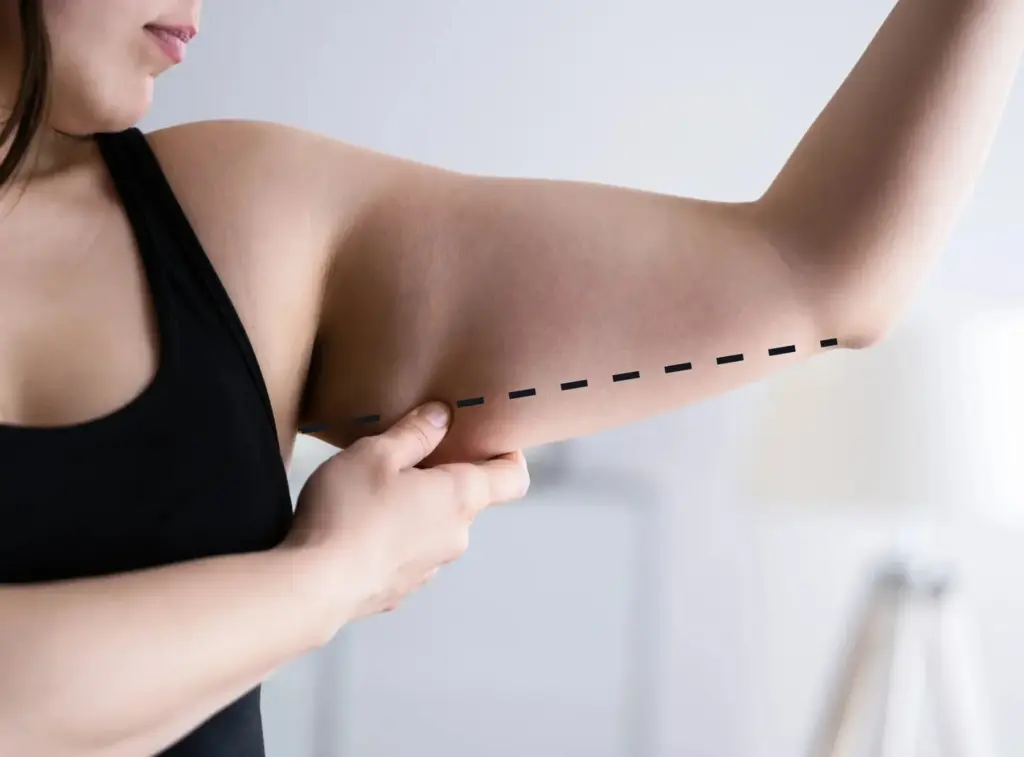
Significant weight reduction, whether accomplished through bariatric metabolic surgery, medical lifestyle interventions, or GLP-1 receptor agonist therapies, is a life-changing milestone. However, massive weight loss frequently leaves behind deflated, inelastic skin envelopes. The upper arms are notoriously vulnerable to this phenomenon, developing redundant skin folds commonly referred to as bat wings. Because stretched elastin fibers cannot retract naturally once skin elasticity is permanently lost, exercise and strength training can only build underlying biceps and triceps muscle without eliminating loose cutaneous tissue. For long-term tightening and anatomical contouring, an arm lift brachioplasty provides a reliable surgical plastic surgery solution.
Individuals considering body contouring often seek clarity on what is brachioplasty surgery, study the management and progression of a brachioplasty scar, examine long-term visual transformations in brachioplasty before and after galleries, review clinical strategies to minimize brachioplasty scars, consider all-inclusive healthcare packages for brachioplasty Turkey, and evaluate clinical variables that determine the overall brachioplasty cost. This clinical guide breaks down surgical incisions, healing benchmarks, scar maturation protocols, and pricing dynamics.
Table of Contents
What Is Brachioplasty Surgery and How Is It Performed?
When researching what is brachioplasty surgery, it is defined as a corrective body contouring procedure that excises redundant, sagging skin and stubborn subcutaneous adipose deposits from the upper arm region, extending from the axilla (armpit) down toward the elbow.
Get Free Consultation
Have any questions? Leave your details and we'll get back to you shortly.
An arm lift re-establishes a harmonious, slender silhouette through several surgical steps:
- Liposuction Contouring: The plastic surgeon often initiates the procedure with tumescent or ultrasound-assisted liposuction (VASER) along the posterior arm. This debulks fatty deposits while preserving sensory nerve branches and lymphatic channels.
- Precision Cutaneous Excision: Redundant skin folds are meticulously mobilized and excised along pre-marked anatomical vectors to prevent excessive skin tension.
- Deep Fascial Suspension: Rather than relying solely on superficial skin sutures, the surgeon anchors the underlying superficial fascial system (SFS) using heavy, slow-resorbing structural sutures. This deep layer suspension prevents post-operative widening of the surgical incision.
- Multi-Layered Wound Closure: The skin is approximated in multiple anatomical layers using absorbable intradermal sutures, followed by the application of medical tissue adhesives (surgical glue) and sterile tapes to support optimal scar maturation.
Surgical Incision Types: Matching Technique to Laxity
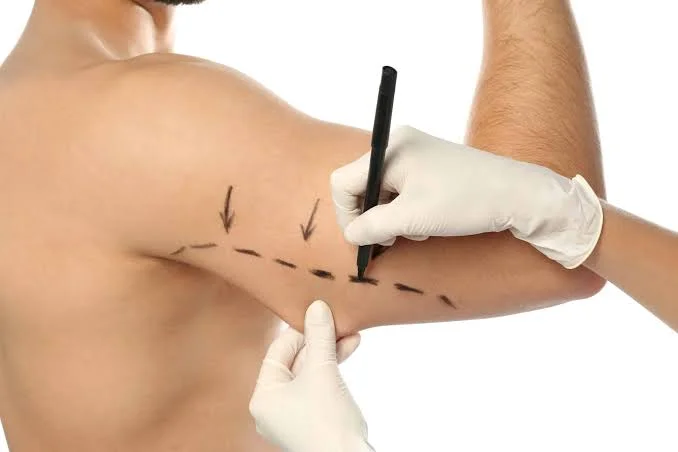
Every patient exhibits a unique degree of skin laxity and fat distribution. Board-certified plastic surgeons customize the surgical approach based on tissue anatomy:
1. Minimal-Incision (Mini or Transaxillary) Brachioplasty
Designed for individuals with mild skin laxity confined strictly to the proximal third of the upper arm near the armpit. The incision is shaped like a crescent or ellipse and hidden entirely within the natural folds of the axilla. It removes localized excess skin without leaving a visible scar along the arm.
2. Standard (Full) Inner-Arm Brachioplasty
The standard approach for moderate-to-severe arm laxity extending along the arm shaft. The incision extends along the inner surface of the arm from the armpit down to the medial epicondyle just above the elbow. By positioning the incision along the medial bicipital groove, the scar remains concealed when the arms are resting naturally against the torso.
3. Extended (L-Shaped or T-Shaped) Brachioplasty
Essential for massive weight loss patients presenting with continuous skin laxity that stretches across the armpit and onto the lateral chest wall. The incision extends from the elbow, traverses the axillary cup, and travels downward along the lateral thoracic cage, treating redundant upper back and lateral chest skin in a single operation.
Scar Maturation: Managing Your Brachioplasty Scar
Understanding the biological lifecycle of a brachioplasty scar is vital for maintaining realistic expectations, as surgical incisions undergo an extended physiological maturation:
- Weeks One to Four (Inflammatory Stage): Surgical incisions remain pink, firm, and slightly raised. Tissues may feel tight when attempting full shoulder elevation. Medical paper tapes or surgical glues remain in place to protect the incision from shear forces.
- Months Two to Three (Proliferative Stage): Incisions can appear redder, darker, or more prominent as new micro-capillaries and collagen fibers populate the area. This represents a normal physiological phase, not surgical failure. Daily application of medical-grade silicone gel sheets or topical silicone scar creams should begin once all crusts have completely detached.
- Months Four to Six (Early Remodeling): The scar gradually begins to soften, flatten, and lighten in color. Gentle scar massage helps break down disorganized collagen bundles.
- Months Nine to Eighteen (Final Scar Maturation): Over time, brachioplasty scars fade into thin, pale lines that blend closely with surrounding skin. While an arm lift trade-off involves permanent linear scarring, patients find that exchange favorable compared to heavy, chafing skin aprons.
Real-World Transformations: Brachioplasty Before and After
Reviewing documented brachioplasty before and after portfolios demonstrates significant functional and aesthetic improvements:
- Restoration of Slender Proportions: Patients gain the ability to wear fitted long-sleeve shirts, tailored jackets, and sleeveless clothing without constriction or bulging.
- Elimination of Friction and Intertrigo: Removing overlapping folds stops painful skin chafing, moisture buildup, chronic maceration, and fungal rashes in the armpits.
- Improved Biomechanical Comfort: Heavy hanging skin produces downward traction during physical activities; excising this tissue makes running, fitness workouts, and overhead lifting noticeably lighter and more comfortable.
- Balanced Body Symmetry: Upper arms are brought into proportion with the rest of a slimmer torso following massive weight loss.
Essential Post-Operative Recovery Guidelines
Protecting the healing incision from mechanical strain ensures smooth tissue integration:
- Wear Medical Compression Sleeves Diligently: Continuous use of graduated compression arm garments for four to six weeks reduces fluid accumulation (seroma), stabilizes soft tissue, and eases tension off the incision lines.
- Arm Elevation: Keep both arms elevated on soft pillows above heart level during sleep for the first seven to ten days to speed up lymphatic drainage and diminish distal hand swelling.
- Avoid Lifting and Over-Extension: Strictly avoid lifting heavy objects (anything over five pounds) and refrain from raising your elbows above shoulder level for at least four weeks to prevent wound dehiscence.
- Strict Sun Protection: Keep healing scars shielded from direct sunlight and UV radiation for twelve months. UV exposure triggers hyperpigmentation, causing permanent darkening of the scar tissue.
Comparative Matrix: Arm Contouring Modalities
| Clinical Parameter | Mini Brachioplasty | Standard Inner-Arm Brachioplasty | Extended Brachioplasty | VASER Liposuction Alone |
| Primary Indication | Mild laxity near armpit | Moderate laxity along arm shaft | Severe laxity extending to chest | Excess fat with firm, elastic skin |
| Scar Placement | Hidden inside armpit | Medial groove (Axilla to elbow) | Elbow to lateral chest wall | Tiny puncture marks (2-3 mm) |
| Skin Excision | Minimal | Substantial | Maximum | None (Skin must retract on its own) |
| Anesthesia Type | Local with sedation or General | General anesthesia | General anesthesia | Local with sedation or General |
| Downtime | 5 to 7 Days | 10 to 14 Days | 14 to 21 Days | 3 to 5 Days |
| Compression Requirement | 2 to 3 Weeks | 4 to 6 Weeks | 6 Weeks | 3 to 4 Weeks |
What Determines the Brachioplasty Cost?
When researching the brachioplasty cost or planning an overseas journey for brachioplasty Turkey, prospective patients will find that procedure pricing is determined by specific clinical, surgical, and logistical factors rather than a single fixed fee:
- Surgical Technique and Incision Complexity: A localized mini arm lift involves less operating room time than an extended brachioplasty addressing both the full arm and the lateral chest wall.
- Concomitant Liposuction: Incorporating high-definition VASER or power-assisted liposuction to sculpt the shoulder transition, deltoid prominence, and posterior arm requires dedicated equipment and additional operating time.
- Surgeon Credentials and Surgical Specialization: Board-certified plastic, reconstructive, and aesthetic surgeons with specific expertise in massive weight loss body contouring reflect their specialized training and complication prevention in their fee structure.
- Hospital and Anesthesiology Facilities: Surgical safety standards require fully accredited surgical hospital theaters, certified anesthesiologists, and overnight post-anesthetic nursing monitoring.
- Geographic Location and Travel Packages: Operational overhead, malpractice structures, and currency dynamics create marked cost differences between domestic metropolitan private hospitals in the US or UK and international healthcare hubs like Turkey. Medical travel programs for an arm lift in Turkey routinely package preoperative lab tests, hospital stays, surgical garments, medications, five-star hotel lodging, and private VIP chauffeur transfers into transparent care packages.
Frequently Asked Questions (FAQ)
Can exercise or weightlifting get rid of bat wings without surgery?
No. While targeted resistance training strengthens the biceps and triceps muscles, exercise cannot eliminate redundant, inelastic skin. When skin elastin fibers have been stretched past their physiological threshold by substantial weight fluctuations, surgical excision is the only definitive clinical method to remove the excess tissue.
Where exactly will my arm lift scar be placed?
For a standard brachioplasty, the incision is placed along the inner aspect of the arm, tracing the medial bicipital groove between the biceps and triceps muscles. This anatomical position conceals the scar from direct view when your arms are resting naturally at your sides or seen from behind.
How soon after surgery can I return to work and resume exercise?
Patients working desk or sedentary jobs typically return to work within ten to fourteen days. Light walking can begin on the first post-operative day to support healthy circulation. However, upper body gym workouts, heavy lifting, tennis, and vigorous sports involving shoulder rotation must be postponed for at least six to eight weeks.
Can brachioplasty be combined with other body contouring procedures?
Yes. Brachioplasty is frequently performed as part of a post-bariatric reconstruction plan alongside a tummy tuck, breast lift (mastopexy), or thigh lift. During clinical evaluation, your plastic surgeon will review operative duration and patient safety parameters to determine whether a combination approach is appropriate for a single surgical session.

 |