Skip to content


Facial aging is a complex, three-dimensional biological process that involves more than superficial cutaneous sagging. Over decades of ultraviolet exposure, gravity, and cellular changes, the retaining facial ligaments that anchor deep fat pads and facial muscles to the underlying facial skeleton lose their structural integrity. When the zygomatic, masseteric, and mandibular retaining ligaments stretch, the malar fat pad of the cheek descends diagonally downward. This descent forms deep nasolabial folds, causes marionette lines, blurs the jawline with heavy jowls, and produces neck banding.
While traditional skin-only or superficial SMAS (Superficial Musculoaponeurotic System) facelifts pull surface tissues horizontally, often creating an unnatural, windblown, or operated look, the deep plane facelift addresses the true underlying anatomy. By entering the sub-SMAS gliding plane and releasing the restrictive retaining ligaments, facial plastic surgeons can reposition descended facial volumes vertically without placing tension on the skin.
Table of Contents
What Is a Deep Plane Facelift and How Does It Work?
If you are researching what is a deep plane facelift, it is an advanced surgical technique where the plastic surgeon operates beneath the superficial musculoaponeurotic system (SMAS) layer of the face. In this plane, the muscles, deep fat pads, and skin move as a unified biological unit, allowing deep tissue repositioning without separating the skin from its underlying vascular bed.
Get Free Consultation
Have any questions? Leave your details and we'll get back to you shortly.
The key anatomical distinction lies in the surgical release of retaining ligaments:
- True Ligamentous Release: Unlike standard SMAS plication (folding) or SMASectomy (cutting away a strip of SMAS), a deep plane approach fully transects the zygomatic and masseteric retaining ligaments. These ligaments act as rigid anchors; unless they are surgically divided, the midface and cheek cannot be elevated vertically.
- Preservation of Subdermal Blood Supply: Because the skin remains attached to the underlying SMAS rather than being extensively peeled back (undermined), the microvascular network feeding the skin remains intact. This preserves microcirculation, significantly reduces the risk of skin necrosis, and promotes cleaner incision healing.
- Midface and Malar Elevation: Traditional facelifts primarily pull the jawline and neck sideways. The deep plane dissection extends medially across the cheek, enabling direct vertical elevation of the fallen malar fat pad back over the cheekbone, eliminating nasolabial folds without synthetic fillers.
- Tension-Free Skin Closure: The entire lifting and holding tension is borne entirely by the deep fibrous SMAS-platysma complex anchored to the solid deep temporal fascia. The overlying skin is simply redraped with zero pull, preventing widened scars or pulled earlobes (pixie ear deformity).
Surgical Technique: Deep Plane vs. SMAS Facelift

Surgeons tailor their facial rejuvenation approach based on the patient’s degree of midface descent, skin elasticity, and structural anatomy:
1. The Deep Plane Dissection
The surgeon places discreet incisions along the natural contour of the ear (inside the tragus and behind the ear into the hairline). Dissection begins subcutaneously for only two to three centimeters in the preauricular area. The surgeon then transitions down into the deep, sub-SMAS avascular glide plane. Staying deep protects the branches of the facial nerve while freeing the zygomatic, upper masseteric, and mandibular retaining ligaments. Once released, the midface, jawline, and platysma muscle in the neck are suspended vertically in their original anatomical positions.
2. High-SMAS Facelift
In this modification, the SMAS layer is entered higher up over the zygomatic arch. While it provides strong cheekbone definition, it often does not release the retaining ligaments as extensively in the mid-cheek region as a true composite deep plane approach.
3. SMAS Plication or SMASectomy
The skin is widely detached from the fat and muscle beneath it. The SMAS is then folded over itself (plication) or a small strip is excised (SMASectomy) and sutured together. While simpler and faster, it leaves the deep retaining ligaments intact, meaning cheek elevation is limited and results may not last as long.
Recovery Roadmap: Deep Plane Facelift Recovery
Because the skin is not separated from its underlying blood supply, the biological timeline for deep plane facelift recovery often involves less surface bruising and faster revascularization than extensive skin-undermining procedures:
- Days One to Three (Acute Phase): Patients wear a soft, supportive facial compression garment to minimize fluid collection. Drainage tubes (if placed) are removed on day one or two. Swelling peaks around day three. Tightness around the jaw and neck is common, but sharp pain is rare and managed with prescribed analgesics.
- Days Four to Seven (Early Wound Healing): Facial bruising begins shifting from deep purple to yellow and green. Fine external skin sutures around the ear are removed between days five and seven. Patients can gently wash their hair with mild baby shampoo.
- Weeks Two to Three (Social Recovery): Around day ten to fourteen, residual bruising can be easily concealed with mineral makeup. Most patients feel confident returning to social activities, restaurants, and remote desk work. Mild tightness and numbness in front of the ears remain normal.
- Months One to Three (Tissue Softening and Integration): Deep swelling resolves, smiling and dynamic facial expressions feel natural, and internal tissues soften.
- Months Six to Twelve (Final Refinement): Surgical scars fade to fine, pale, virtually imperceptible lines tucked inside the ear folds. The jawline and midface show crisp, youthful definition.
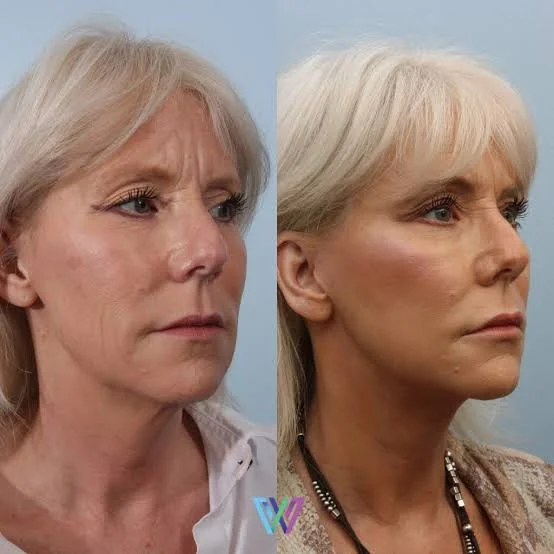
Clinical Transformations: Deep Plane Facelift Before and After
Examining documented deep plane facelift before and after clinical portfolios illustrates structural, natural transformations:
- Restoration of Cheekbone Volume: Fallen cheek volume is restored naturally over the zygomatic bones without the doughy appearance associated with overfilled dermal fillers.
- Crisp, Defined Jawline: Jowls along the mandible are completely eliminated, restoring a straight, continuous jaw contour from chin to ear.
- Smoothing of the Midface: Deep nasolabial folds (smile lines) and marionette lines are substantially softened because the cheek fat pads are repositioned vertically.
- Rejuvenated Neck Architecture: When paired with a deep neck lift or platysmaplasty, platysmal bands and submental fullness disappear, establishing an acute cervicometal angle.
- Completely Natural Expression: Because the skin is never pulled tight horizontally, the mouth corners do not stretch, and the patient retains their natural facial identity.
Comparative Matrix: Deep Plane vs. SMAS vs. Mini Lift
| Clinical Parameter | Deep Plane Facelift | Standard SMAS Facelift | Mini Lift (MACS Lift) |
| Dissection Plane | Sub-SMAS / Sub-Platysmal | Subcutaneous with SMAS folding | Superficial subcutaneous only |
| Ligament Release | Complete (Zygomatic & Masseteric) | None or partial | None |
| Midface (Cheek) Elevation | Superior / Vertical restoration | Minimal to moderate | None (Jawline only) |
| Skin Vascularity | High (Skin remains attached to SMAS) | Reduced (Extensive skin peeling) | Moderate |
| Tension on Skin Edges | Zero tension (Deep layer holds weight) | Moderate tension | High tension |
| Expected Result Longevity | 12 to 15 Years | 7 to 10 Years | 3 to 5 Years |
| General Recovery Time | 10 to 14 Days (Social) | 14 to 21 Days | 7 to 10 Days |
What Determines the Deep Plane Facelift Cost?
Prospective patients researching the overall deep plane facelift cost or exploring specialized surgical journeys for a deep plane facelift Turkey will discover that pricing varies based on individual anatomy, clinical factors, and surgical scope:
- Surgical Complexity and Operating Room Time: A true deep plane dissection is one of the most anatomically demanding operations in aesthetic plastic surgery, typically requiring three to five hours of precise microsurgical dissection to navigate around facial nerve branches.
- Concomitant Procedures: Deep plane facelifts are rarely performed in isolation. They are frequently paired with deep neck lifts, submandibular gland suspension, platysmaplasty, upper and lower blepharoplasty, lip lifts, or fat grafting to the temples and tear troughs, all of which influence operating time and surgical fees.
- Surgeon Expertise and Subspecialty Training: Experienced facial plastic surgeons who specialize specifically in sub-SMAS and deep plane architecture command professional fees that reflect their technical skill and low complication rates.
- Anesthesia and Hospital Facility Standards: Deep plane operations require accredited surgical hospitals, experienced general anesthesiologists, and overnight post-surgical nursing observation.
- Geographic Location and Package Inclusions: Operating room overhead, malpractice insurance, and currency factors create noticeable price differences between private practices in North America or Western Europe and internationally accredited centers in Turkey. Deep plane facelift packages in Turkey frequently bundle pre-operative blood panels, advanced 3D imaging, surgical hospital stays, postoperative garments, medications, five-star hotel lodging for seven to ten days, and private VIP chauffeur transfers into transparent care packages.
Frequently Asked Questions (FAQ)
Is a deep plane facelift more dangerous than a standard facelift?
When performed by a board-certified facial plastic surgeon or plastic surgeon with dedicated sub-SMAS fellowship training, the deep plane technique is safe and predictable. Dissection in the sub-SMAS plane is actually performed in a relatively bloodless, natural anatomical glide space. Because the surgeon operates directly beneath the SMAS layer, the facial nerve branches are visually identified and protected, rather than being subjected to blind puncture from deep plication needles.
How long does a deep plane facelift last compared to other methods?
A deep plane facelift offers the longest-lasting results of any facial rejuvenation technique, typically between twelve and fifteen years. Because the true retaining ligaments are released and the structural muscles are permanently repositioned and suspended to deep fascia, the restoration resists gravitational pull far longer than procedures that rely on skin tightening or superficial SMAS stitching.
Will I look unnatural, stretched, or operated on?
No. An unnatural, windblown, or pulled appearance occurs when surgeons attempt to lift facial features by pulling the skin horizontally under high tension. In a deep plane facelift, zero tension is placed on the skin. The deeper muscular and fat structures are restored to where they were ten to fifteen years earlier, resulting in a rested, refreshed, and natural appearance.
At what age is a deep plane facelift typically performed?
While most patients seek a deep plane facelift between the ages of forty-five and sixty-five when midface descent and jowls become pronounced, candidacy is based on anatomical aging rather than chronological age. Patients in their late thirties with premature structural laxity or post-bariatric volume loss, as well as individuals in their seventies with good systemic health, can achieve transformative results.

 |