Skip to content

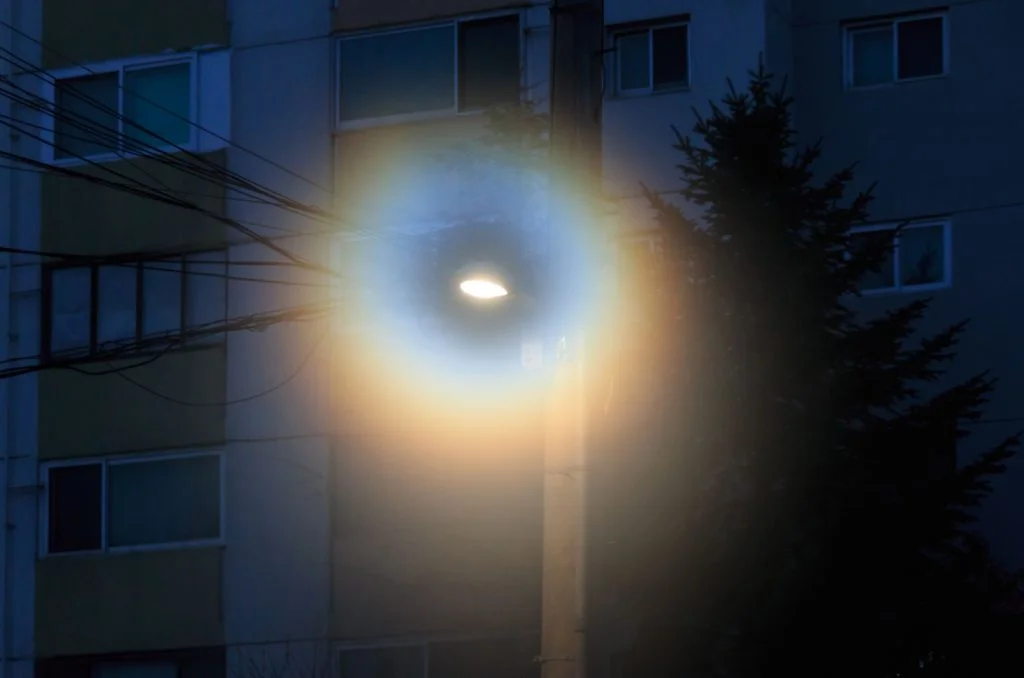
Navigating dark roads or walking through illuminated city streets requires crisp, uninterrupted visual clarity. However, many people notice bright, glowing rings, starbursts, or colorful circles surrounding streetlamps, headlights, and indoor light fixtures. This visual phenomenon is clinically known as visual halos.
If you are asking yourself, “why do I see halos around lights at night?” or noticing bright rainbow halos around lights at night, it is essential to understand how light refracts through your ocular structures. While occasional visual glare can stem from simple, benign factors like dry eyes or dirty eyeglasses, seeing halos around lights at night can also serve as an early warning indicator for underlying ophthalmic conditions, such as cataracts, acute angle-closure glaucoma, or corneal swelling. This comprehensive clinical guide explores what causes halos around lights at night, addresses whether is it normal to see halos around lights at night, and details modern diagnostic and treatment solutions.
Table of Contents
What Are Visual Halos and How Do They Form?
To understand why you might say, “I see halos around lights at night,” we must examine how light enters the human eye. Under normal conditions, light passes cleanly through the transparent outer window (cornea), through the pupil, and through the crystalline lens, focusing directly onto the light-sensitive tissue at the back of the eye (retina).
Get Free Consultation
Have any questions? Leave your details and we'll get back to you shortly.
Visual halos occur when light rays scatter or refract unevenly before reaching the retina. When the smooth, transparent pathways of the cornea or crystalline lens become cloudy, swollen, or misshapen, incoming light bends abnormally. This scattering creates glowing circles or colored rings directly around concentrated light sources, becoming particularly noticeable in dark environments when pupils dilate to let in more light.
What Causes Halos Around Lights at Night? Primary Ocular Conditions

Understanding the root cause of nighttime visual distortion requires evaluating several key eye conditions:
1. Cataracts (Clouding of the Natural Lens)
A cataract is the progressive clouding of the eye’s natural crystalline lens, typically caused by aging or long-term UV exposure. As proteins within the lens clump together, they break up incoming light rays rather than focusing them sharply. This light diffraction is a primary cause of nighttime halos, glare, and faded color perception.
2. Dry Eye Syndrome (Ocular Surface Instability)
A smooth, continuous tear film over the cornea is vital for sharp vision. When the eyes are chronically dry, the tear film breaks up rapidly, creating microscopic dry patches across the corneal surface. Light passing through these rough areas scatters irregularly, triggering temporary halos and starbursts that often improve after blinking or using lubricating drops.
3. Acute Angle-Closure Glaucoma (Ocular Emergency)
A sudden, severe rise in intraocular pressure (IOP) can force fluid into the corneal tissue, causing corneal edema (swelling). This fluid buildup alters the light-bending properties of the cornea, causing patients to see dramatic rainbow halos around lights at night.
URGENT WARNING: If rainbow halos are accompanied by sudden severe eye pain, intense headache, blurred vision, nausea, or vomiting, seek emergency medical care immediately. This signals acute angle-closure glaucoma, which can cause permanent vision loss if untreated.
4. Corneal Distortions (Keratoconus and Astigmatism)
Irregularities in the shape of the cornea prevent light from focusing on a single point. Astigmatism (an oval-shaped cornea) or keratoconus (progressive thinning and coning of the cornea) cause light rays to refract unevenly, producing stretched, elongated halos, or starburst shapes.
5. Post-Refractive Surgery Healing (LASIK / PRK / ICL)
During the early months following corneal laser surgery (LASIK/PRK) or intraocular lens placement (ICL), temporary corneal edema, flap healing, or pupil dilation beyond the treated zone can cause temporary nighttime halos and glare.
Is It Normal to See Halos Around Lights at Night?
When evaluating nighttime vision, patients frequently ask: is it normal to see halos around lights at night?
The short answer is no, persistent visual halos are not considered a normal physiological state, though minor, fleeting light flare can occasionally occur under specific conditions:
- When It May Be Benign: Minor glare caused by uncleaned eyeglasses, contacts worn for too long, low-grade dry eyes after staring at digital screens, or the temporary healing phase (first 1 to 3 months) following LASIK or cataract surgery.
- When It Is Pathological: Any persistent, worsening, or sudden halo visual distortion that interferes with nighttime driving, does not resolve after blinking, or is accompanied by pain, redness, or decreased visual acuity requires prompt clinical evaluation by an eye care professional.
Diagnostic Timeline and Medical Solutions
Addressing visual halos requires identifying the precise anatomical location of light scattering. Modern ophthalmic clinics use structured diagnostic and therapeutic protocols:
1. Comprehensive Ophthalmic Diagnostics
- Slit-Lamp Examination: Evaluates the health of the corneal surface, tear film stability, and natural lens clarity.
- Corneal Topography: Maps the curvature and surface smoothness of the cornea to detect astigmatism, keratoconus, or post-LASIK irregularities.
- Tonometry: Measures intraocular pressure to rule out glaucoma.
- Dilated Fundus Exam: Evaluates the optic nerve and retina to ensure back-of-eye health.
2. Medical and Surgical Treatment Pathways
- Prescription Lubricating Eye Drops or Punctal Plugs: Restores a smooth, continuous tear film for dry eye-induced halos.
- Updated Eyeglasses or Specialized Contact Lenses: Corrects unmanaged astigmatism or refractive errors using anti-reflective coatings.
- Cataract Surgery (Intraocular Lens Replacement): Removes the cloudy natural lens and replaces it with a clear monofocal or premium intraocular lens (IOL), permanently resolving cataract-induced halos.
- Glaucoma Management: Employs pressure-lowering eye drops, laser iridotomy, or surgical drainage to lower IOP and clear corneal edema.
Comprehensive Clinical Assessment Matrix
| Metric / Parameter | Cataracts | Dry Eye Syndrome | Acute Glaucoma | Post-LASIK / PRK |
| Primary Halo Description | Dull, glowing rings & starbursts | Transient rings, clears when blinking | Bright rainbow halos | Starbursts, rings in low light |
| Pain Level | Painless, gradual onset | Mild burning, grittiness | Severe, acute eye pain & headache | Mild discomfort during early healing |
| Associated Symptoms | Faded colors, night vision drop | Foreign body sensation, tearing | Nausea, vomiting, sudden redness | Temporary dryness, light sensitivity |
| Medical Urgency | Non-urgent (Elective surgery) | Non-urgent (Conservative care) | EMERGENCY (Immediate care required) | Routine post-op monitoring |
| Primary Treatment | Cataract removal & IOL replacement | Preservative-free drops, punctal plugs | IOP-lowering medication or laser | Time, lubricating drops, enhancement |
Frequently Asked Questions (FAQ)
Why do I see rainbow halos around lights at night?
Rainbow halos around lights are typically caused by corneal edema (swelling of the cornea). When fluid enters the corneal layers, it acts like a prism, breaking incoming white light into its spectrum of individual colors. Common causes include acute intraocular pressure spikes (glaucoma), severe contact lens overuse, or recent eye surgery.
Can dirty eyeglasses or contact lenses cause halos around lights at night?
Yes. Smudges, dust, facial oils, or micro-scratches on eyeglasses scatter light before it enters your eye, producing noticeable halos and streaks. Similarly, dirty, dry, or damaged contact lenses disrupt the tear film and cause significant light diffraction. Always clean your eyewear thoroughly before seeking medical evaluation.
Do halos around lights go away on their own after cataract surgery?
Yes, in most cases. Temporary halos and glare are common during the first 1 to 3 months following cataract surgery as the eye heals, swelling subsides, and the brain adapts to the new intraocular lens. If halos persist beyond 6 months, your eye surgeon can evaluate the IOL positioning or treat posterior capsule opacification (PCO) with a quick YAG laser procedure.
When should seeing halos around lights at night be treated as an emergency?
You should seek emergency eye care immediately if halos appear suddenly and are accompanied by severe eye or facial pain, intense headache, nausea, vomiting, sudden blurred vision, or extreme eye redness. These symptoms indicate a potential acute glaucoma attack, which requires rapid medical intervention to prevent optic nerve damage.

 |
|