Skip to content
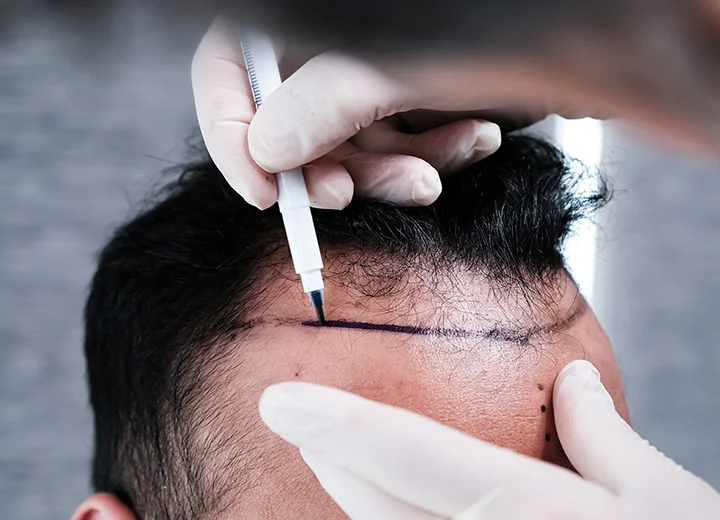
The anterior hairline is the primary aesthetic frame of the human face. It directly dictates the visual harmony of facial proportions, the vertical balance of the forehead, and the perceived biological age of an individual. When progressive hair loss shifts the hairline backward or creates deep temporal recessions, the entire symmetry of the face is disrupted. A successful hair restoration journey is never measured simply by the gross volume of transplanted grafts, but primarily by the accurate, artistic positioning of those grafts.
Hairline design is a highly specialized discipline that seamlessly combines mathematical precision, advanced craniofacial anatomy, and genuine artistic talent. Creating an unnaturally straight line or applying the incorrect exit angle to the implanted follicles leads directly to an artificial, doll-like appearance. This comprehensive clinical guide breaks down how top surgeons map out the perfect hairline, explores demographic and gender-specific design variations, details extraction protocols, and reviews non-surgical concealment alternatives.
Table of Contents
Why Is the Hair Transplant Hairline Design the Most Critical Step of the Procedure?
The ultimate success of an advanced hair restoration procedure relies on the illusion of complete undetectability. The hair transplant hairline design is the most critical phase of the operation because the human eye is naturally trained to recognize facial asymmetries and artificial geometric patterns instantly.
Get Free Consultation
Have any questions? Leave your details and we'll get back to you shortly.
When planning a custom hairline design for hair transplant configurations, three foundational rules must be satisfied: avoiding placement directly over active forehead muscle tissue, texturing the transition zone with micro-irregularities, and selecting the correct follicle groupings. When these details are meticulously executed, the transplanted hair blends seamlessly, making it impossible to distinguish from organic growth.
How Does a Professional Hair Transplant Hairline Design Consultation Proceed?
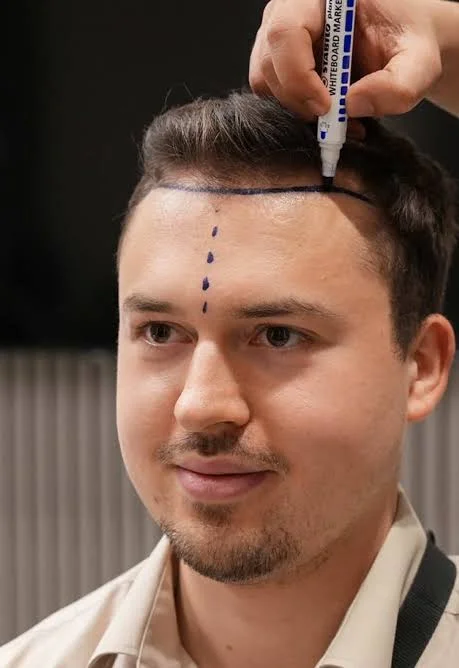
A premium result is engineered long before the primary surgical steps begin. During a comprehensive hair transplant hairline design consultation, the specialist analyzes the patient’s unique facial anatomy using a strict mathematical formula known as the “Rule of Thirds.” According to this anatomical standard, a perfectly balanced face is divided into three vertically equal segments: from the base of the chin to the bottom of the nose, from the nose to the glabella (the area between the eyebrows), and from the glabella to the newly designed hairline.
Furthermore, the surgeon carefully maps out the movement of the forehead muscle (the frontalis muscle). The new hairline must always be positioned at least 1 to 2 centimeters above the highest boundary of this muscle. If grafts are placed directly over the muscle tissue, the hair will move unnaturally up and down whenever the patient expresses facial emotions or raises their eyebrows.
How Does the Hairline Design for Men Differ from Female Anatomical Blueprints?
Male and female hairlines follow completely distinct geometric templates, requiring contrasting surgical approaches tailored to each gender:
1. Hairline Design for Men
The natural male hairline never follows a smooth, circular arc. An optimal hairline design for men requires a masculine V-shape or a soft, mature W-shape silhouette. Even when treating a young patient in their 20s, the surgeon must proactively resist the temptation to lower the line excessively. Leaving slight, age-appropriate recessions in the temple angles ensures that the results remain authentic and natural when the patient reaches their 40s or 50s.
2. Female Hairline Design
In stark contrast, a professional female hairline design is defined by a completely soft, rounded, and continuous oval form. Women rarely experience localized temporal recessions; instead, their hair loss presents as diffuse thinning. Designing a feminine hairline requires closing the temple angles using soft curves and placing ultra-fine single hair grafts at the very front to maintain classic feminine framing.
How Does the FUE Hair Transplant Hairline Design Maximize Visual Naturalness?
The choice of micro-surgical technology directly impacts how safely and precisely a design can be executed. An advanced fue hair transplant hairline design protocol utilizes high-magnification stereomicroscopes to sort extracted grafts strictly by their hair count. For the first 1 to 3 rows of the front hairline the surgeon uses exclusively single-hair grafts.
Thicker, multi-hair grafts (containing 2, 3, or 4 hairs) are placed at least 1 to 2 centimeters behind the front line to build up visual volume and depth. Furthermore, the surgeon maps out the fue hair transplant hairline design using an irregular, macro-and-micro zikzak pattern, perfectly copying the un-uniform layout of nature. The exit angle is also critical: frontal hairs must be implanted at a shallow angle of 15 to 20 degrees, directed forward and slightly outward following the natural swirl of the scalp.
Why Is the Back Hairline Design Given Equal Priority in Advanced Clinics?
While the primary focus is almost always placed on the forehead, the back of the head requires equal aesthetic precision. A professional back hairline design is essential to ensure the donor area looks natural and unscarred after extraction.
During FUE harvesting, the lower border of the natural hair roots in the neck and nape region must not be aggressively overharvested or stripped away. The surgeon must preserve a clean, masculine block or a soft feminine contour. A clean back hairline design guarantees that the patient can comfortably wear their hair exceptionally short months after surgery without exposing an irregular, moth-eaten donor pattern.
When Should Scalp Micropigmentation Hairline Design Be Considered as an Alternative?
For individuals who wish to completely avoid surgical incisions, or patients with completely depleted donor hair pools, a scalp micropigmentation hairline design (SMP) provides an exceptional non-surgical option. This method uses specialized medical-grade organic pigments deposited into the upper epidermal layer of the skin.
Executing a scalp micropigmentation hairline design requires following the exact same facial mapping and geometric rules as a surgical procedure. The SMP specialist maps out the hairline and prints micro-dots in varying shades and gradient patterns (fading). This creates a hyper-realistic visual illusion of a freshly shaved, high-density head of hair, and is also an outstanding tool to add density between previously transplanted surgical hair grafts.
What Do the Hair Transplant Hairline Design Before After Timelines Reveal?
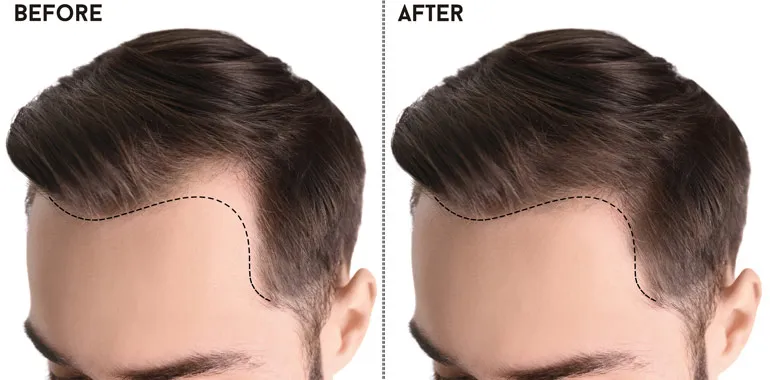
The complete re-balancing of facial aesthetics becomes visually undeniable when studying a verified hair transplant hairline design before after timeline. Before surgery, patients often present with a chronically high forehead and hollow temple lines that make them look prematurely aged or tired.
The compiled hair transplant hairline design before after results show how a perfectly reconstructed hairline instantly resets the facial frame, shifts attention back to the eyes, and restores lifelong self-confidence. In a premier design, the results blend so perfectly with your remaining native hair that unless you explicitly tell someone you had a transplant, the intervention remains entirely undetectable.
Comprehensive Restoration Comparison
| Design Parameter / Feature | Surgical FUE Hairline | Scalp Micropigmentation (SMP) |
| Primary Methodology | Relocation of live, organic hair follicles | Targeted medical micro-pigment injection |
| Invasiveness Level | Minimally invasive micro-surgery | Non-surgical cosmetic shading |
| Erzielte Structure | Real, 3-dimensional growing hair shafts | 2-dimensional visual follicle replication |
| Transition Zone Management | Single-hair grafts placed in macro-zikzaks | Micro-dot pixel density fading at the front |
| Long-Term Durability | Permanent (Lifetime follicle growth) | Semi-permanent (Requires refresh in 3-5 years) |
| Directional Control | Full alignment (15-20 degree directional angling) | Not applicable (Flat surface pigmentation) |
Frequently Asked Questions (FAQ)
Can a hairline that was designed too low or incorrectly be fixed?
Yes, an incorrectly positioned or poorly designed hairline can be corrected through specialized revision surgeries. Grafts that were placed too low or in an unnaturally straight line are gently extracted one by one using micro-punches. The extraction sites heal within a few days, and the hairline can be re-contoured higher up following proper facial proportions during a secondary session.
Will my newly designed hairline look unnatural as I grow older?
If your hairline was mapped out using “age-appropriate and sustainable” principles during your consultation, it will never look unnatural as you age. The transplanted donor hair is genetically resistant to hair loss hormones and grows permanently. However, your native hair behind the transplant may continue to thin over time, which is why matching medical therapies or mesotherapies are often recommended to maintain density.
What is the single most critical detail to avoid the “pluggy” doll-head look?
The single most critical detail is ensuring that no multi-hair grafts are ever placed in the very first row of the hairline. The front edge must be built exclusively using soft single-hair follicles arranged in a slightly irregular, random zikzak pattern. Avoiding a laser-straight line completely eliminates any artificial appearance.

 |
|