Skip to content
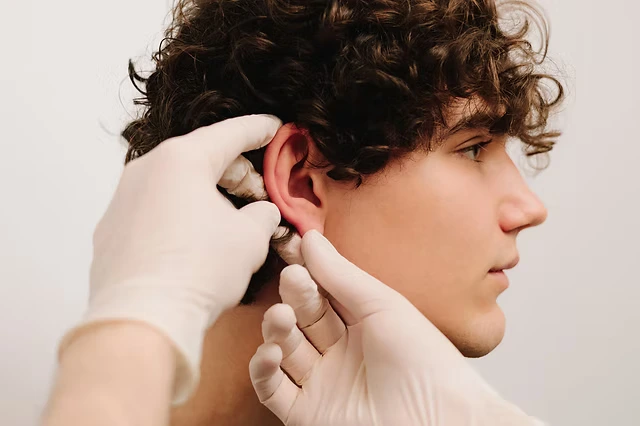
Prominent, protruding, or asymmetric ears can impact self-confidence from early childhood well into adulthood. Anatomical variations, such as an underdeveloped antihelical fold or an enlarged, deep conchal bowl, prevent the ear from sitting naturally against the head. Because the ear cartilages are fully developed by approximately five to six years of age, cosmetic reshaping can be performed safely across both pediatric and adult populations.
A customized otoplasty (commonly known as ear pinning or cosmetic ear surgery) repositions the ears closer to the sides of the head, reshapes natural contours, and restores bilateral facial symmetry.
Table of Contents
What Is Otoplasty and How Does Ear Pinning Work?
If you are wondering what is otoplasty, it is a plastic and reconstructive surgical procedure designed to correct the size, shape, position, or proportion of the ears.
Get Free Consultation
Have any questions? Leave your details and we'll get back to you shortly.
The human ear framework consists of flexible, elastic cartilage covered by a thin layer of perichondrium and skin. Protrusion typically stems from two primary structural variations:
- Conchal Hypertrophy: An overdeveloped, excessively deep central cup (concha) that projects the entire ear outward away from the skull.
- Poorly Defined Antihelical Fold: The failure of the cartilage to fold backward along the upper rim, resulting in a flat, cup-like ear.
SURGICAL CARTILAGE RESHAPING PROTOCOL:
- [Post-Auricular Incision]: Hidden completely in the natural posterior sulcus behind the ear
- [Cartilage Remodeling]: Scored, weakened, or partially excised (Mustardé & Furnas sutures)
- [Conchomastoid Suture]: Anchors ear cartilage to the mastoid fascia to set cranial distance
- [Bilateral Symmetry Set]: Auriculocephalic distance adjusted to a natural 15 to 20 mm profile
During otoplasty surgery, the plastic surgeon accesses the cartilage via an incision placed along the posterior crease where the back of the ear meets the head. The surgeon weakens the cartilage spring through scoring or shaving, places permanent internal sutures (such as Mustardé horizontal mattress sutures to recreate the antihelical fold, and Furnas sutures to set back the conchal bowl), and removes any redundant posterior skin without leaving visible anterior scars.
Gender-Specific Considerations: Otoplasty for Men
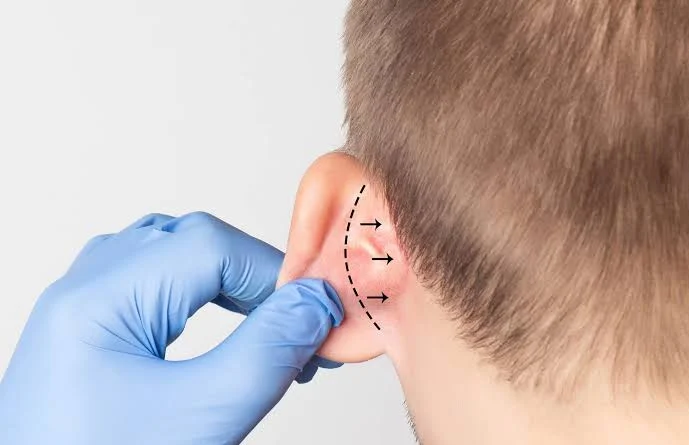
Demand for otoplasty for men represents a substantial portion of cosmetic ear surgeries. Male facial anatomy requires targeted surgical planning:
- Incision Concealment with Short Hair: Male patients frequently wear short hair or experience genetic hairline recession. Because the incision is placed precisely within the post-auricular groove behind the ear, scars remain hidden even with a fade, buzzcut, or closely cropped hairstyle.
- Preserving Cartilage Rigidity: Male auricular cartilage is often thicker, stiffer, and less pliable than female cartilage. Surgeons must carefully score and release the cartilage spring to prevent suture pull-through or relapse.
- Natural Angular Contour: The goal in male ear pinning is to avoid an “over-pinned” or pinned-back, artificial appearance. A masculine outcome preserves a natural cranial distance of approximately 15 to 20 millimeters from the temporal bone to the helical rim.
Visualizing Results: Otoplasty Before and After
Reviewing otoplasty before and after patient timelines highlights key anatomical changes:
- Symmetrical Auriculocephalic Angle: The angle between the side of the head and the ear is brought down from a prominent 30 to 45 degrees to a normal, aesthetic 15 to 20 degrees.
- Creation of Soft Anatomical Folds: The upper pole of the ear regains a smooth, natural curve rather than a sharp, flat, or folded edge.
- Reduction of Conchal Bowl Prominence: The ear sits flatter without being pulled unnaturally tight against the scalp.
- Scar Maturation Behind the Ear: Within 6 to 12 months, the thin incision line behind the ear fades to an imperceptible pale line hidden within the natural fold.
Recovery Milestones: Otoplasty Recovery Time
The otoplasty recovery time is relatively brief, allowing patients to resume normal non-strenuous routines quickly:
OTOPLASTY HEALING TIMELINE:
- Days 1 to 3 (Acute Phase): The ears are wrapped in a soft, bulky turban-style head dressing to protect the newly positioned cartilage, maintain gentle compression, and prevent hematoma formation. Mild throbbing or aching is normal and well controlled with prescribed pain relievers.
- Day 7 (Bandage Removal): The initial head dressing and external skin sutures are removed in the clinic. The ears will appear mildly swollen and bruised. Patients are instructed to wear an elastic tennis-style headband at night to prevent the ears from bending forward during sleep.
- Weeks 2 to 3 (Return to Routine): The majority of bruising and swelling subsides. Adults can comfortably return to office jobs and school within 5 to 7 days.
- Weeks 6 to 8 (Structural Stabilization): Internal scar tissue firmly anchors the ear cartilage in its permanent position. Rigorous exercise, contact sports (such as martial arts, basketball, and rugby), and wearing tight motorcycle helmets are cleared.
Comprehensive Surgical & Non-Surgical Comparison Matrix

| Clinical Parameter | Incision-Based Cartilage Otoplasty | Incisionless Suture Otoplasty | Non-Surgical Ear Molding (Infants) |
| Target Population | Adults, teens, and children (>5 years) | Select adults with flexible cartilage | Newborns only (First 2 to 6 weeks of life) |
| Incision Location | Posterior crease behind the ear | Tiny microscopic needle punctures | Zero incisions (Silicone splint molds) |
| Cartilage Remodeling | Direct scoring, excision, and suturing | Suture fixation through skin | Molded by maternal estrogen elasticity |
| Permanence | Permanent (<3% relapse rate) | Moderate (Higher long-term suture failure) | Permanent (If applied early) |
| Anesthesia Type | Local anesthesia or IV sedation | Local anesthesia | None required |
| Downtime | 5 to 7 Days | 2 to 3 Days | Zero downtime |
What Determines the Otoplasty Cost?
Prospective patients researching otoplasty cost will find that pricing is influenced by multiple surgical, geographic, and facility variables rather than a single flat fee:
- Geographic Location and Clinic Overhead: Surgical fees vary considerably between countries and regions. In the UK, US, and Western Europe, clinic overhead and surgeon fees are significantly higher than in accredited medical tourism destinations like Turkey.
- Surgical Complexity and Asymmetry: Correcting a single prominent ear (unilateral otoplasty) requires a different surgical scope than treating severe bilateral conchal hypertrophy, constricted ears, or revision surgeries requiring ear cartilage grafting.
- Type of Anesthesia Administered: Performing the surgery under straight local anesthesia in an accredited outpatient clinic reduces overall costs compared to general anesthesia or deep IV sedation administered by a board-certified anesthesiologist in a hospital operating theater.
- Surgeon Expertise: Board-certified plastic surgeons or facial plastic and ENT specialists with extensive experience in pediatric and adult ear reconstruction set their fees based on specialization and procedural track record.
- All-Inclusive Packages in Otoplasty Turkey: Medical tourism programs in Turkey frequently bundle surgical fees, pre-operative blood panels, hospital facility fees, post-operative medications, protective headbands, hotel accommodation (4 to 5 nights), and private VIP airport-clinic transfers into one single comprehensive arrangement.
Frequently Asked Questions (FAQ)
Can the ears pop back out or return to their original position after otoplasty?
Permanent relapse occurs in less than 3 percent of cases. During surgery, permanent internal sutures anchor the cartilage into its new position while internal scar tissue matures over 6 to 8 weeks to lock the structure permanently. Wearing the protective headband at night as directed is critical to prevent accidental trauma from bending the ears forward during early healing.
Will otoplasty surgery affect my hearing?
No. Otoplasty alters only the outer ear cartilage and external skin (the pinna or auricle). It does not involve the middle ear, the inner ear, or the external auditory canal, so hearing acuity is completely unaffected.
At what age can a child safely undergo otoplasty?
Ear cartilage reaches approximately 85 to 90 percent of its adult size by age five or six. Performing otoplasty at this age is ideal because the cartilage is pliable and easy to mold, and the surgery spares the child from potential psychological teasing or bullying during primary school years.
Is otoplasty surgery painful during recovery?
The surgery itself is painless under local anesthesia or sedation. Over the first 48 to 72 hours post-operatively, patients typically experience mild to moderate aching, throbbing, or pressure from the protective head bandage. These symptoms are easily managed with standard oral analgesics and improve significantly once the primary dressing is removed.

 |
|