Skip to content
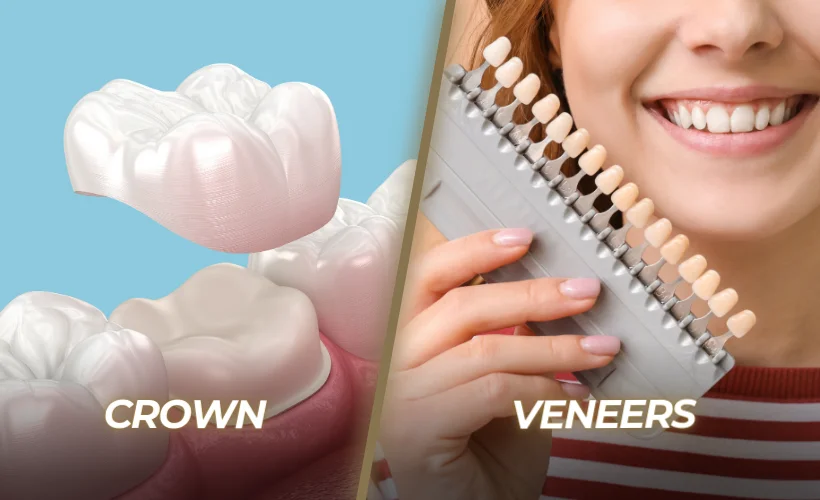
Restoring broken, discolored, or structurally compromised teeth requires choosing the appropriate indirect dental restoration. Modern cosmetic and restorative dentistry offers two primary treatment pathways: custom porcelain veneers and full-coverage dental crowns. While both solutions deliver lifelike aesthetics and natural smile transformations, they serve fundamentally different clinical purposes, require distinct tooth preparation methods, and differ in structural coverage.
Understanding the clinical distinction between dental veneers vs crowns is crucial before committing to a treatment plan. Prospective patients frequently evaluate what are veneers vs crowns, compare veneers vs crowns front teeth applications, analyze porcelain veneers vs crowns price differences, question veneers vs crowns which last longer, and study veneers vs crowns pros and cons. This comprehensive medical guide provides a detailed clinical comparison, explains preparation depths, outlines longevity data, and guides your restorative decision.
Table of Contents
What Are Veneers vs. Crowns?
The fundamental difference between teeth veneers vs crowns lies in the surface area of the tooth that the restoration covers:
Get Free Consultation
Have any questions? Leave your details and we'll get back to you shortly.
RESTORATION COVERAGE COMPARISON:
- Veneer: [Enamel Facing (0.3 to 0.7 mm)] -> Covers Front/Facial Surface Only -> Preserves Lingual Structure
- Crown: [360° Full Cap (1.0 to 2.0 mm)] -> Encapsulates Entire Tooth Core -> Maximum Structural Reinforcement
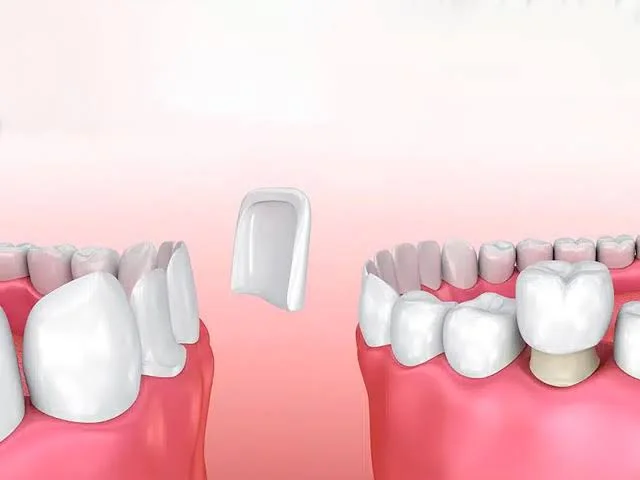
- Dental Veneers: Ultra-thin, custom-fabricated shells of lithium disilicate (E-Max) or feldspathic porcelain bonded exclusively to the front (facial) surface and biting edge of the tooth. Veneers are primarily cosmetic solutions designed to enhance tooth shade, close gaps, fix minor chips, and refine tooth shape while preserving 80 to 90 percent of the natural tooth structure.
- Dental Crowns: Full-coverage “caps” that enclose the entire visible portion of the tooth down to the gumline (360-degree coverage). Crowns are restorative and protective solutions engineered to rebuild teeth that have suffered severe decay, large fractures, root canal therapy, or heavy structural loss.
Preparation and Tooth Reduction: Veneers vs. Crowns Teeth Comparison
The degree of irreversible tooth trimming is the most critical biological factor distinguishing these two treatments in a veneers vs crowns teeth comparison:
- Veneer Preparation (Minimal Enamel Shaving): Requires conservative reduction of only 0.3 mm to 0.7 mm of front enamel. In some no-prep or ultra-thin ceramic cases, shaving is minimal or completely avoided, keeping the restoration bonded directly within the strong enamel layer.
- Crown Preparation (Substantial Circumferential Trimming): Requires shaving 1.0 mm to 2.0 mm of tooth structure from all sides (facial, lingual, interproximal, and occlusal). Approximately 50 to 75 percent of the natural tooth structure is removed to create adequate space for the restorative material.
Clinical Indications: When to Choose Veneers vs. Crowns Front Teeth
Selecting between veneers vs crowns front teeth restorations depends on the remaining healthy tooth volume and bite mechanics:
When Veneers Are the Ideal Choice:
- Severe intrinsic tooth staining (such as tetracycline stains or fluorosis) that resists professional teeth whitening.
- Minor cosmetic alignment issues, small gaps (diastemas), or uneven tooth lengths.
- Chipped or worn incisal edges where the underlying tooth core remains completely healthy and intact.
- Patients with healthy bite alignment and no severe teeth grinding (bruxism).
When Crowns Are the Necessary Choice:
- Extensive structural destruction caused by deep dental cavities or large failing fillings.
- Cracked or fractured teeth where biting forces could split the remaining root.
- Teeth that have undergone endodontic treatment (root canal therapy), which leaves the tooth brittle and hollow.
- Heavy bruxism or severe bite collapse where full 360-degree reinforcement is needed to prevent catastrophic breakage.
Durability and Longevity: Veneers vs Crowns Which Last Longer?
When evaluating veneers vs crowns which last longer, both options offer impressive longevity when maintained with meticulous oral hygiene:
- Porcelain Veneers Lifespan: High-grade porcelain and E-Max veneers typically last between 10 and 15 years. Because they are bonded to outer enamel, failure usually occurs from minor debonding, chip damage from trauma, or gum recession exposing margin borders.
- Dental Crowns Lifespan: Crowns average 15 to 20+ years of functional life. Because they encapsulate the tooth entirely, they withstand heavy posterior masticatory forces. Crown failure is most often caused by recurrent secondary decay at the gum margin or underlying tooth fracture.
Evaluating Veneers vs. Crowns Pros and Cons
A balanced assessment of veneers vs crowns pros and cons clarifies which restoration matches your dental health status:
Veneers: Pros and Cons
- Pros: Highly conservative (preserves natural tooth structure); unmatched natural translucency and gloss; gentle on surrounding gum tissues; stain-resistant porcelain surfaces.
- Cons: Irreversible once enamel is shaved; unsuitable for severely broken or weak teeth; cannot withstand severe teeth grinding; higher risk of chipping under heavy bite forces.
Crowns: Pros and Cons
- Pros: Restores severely decayed or damaged teeth; provides 360-degree protection against biting fractures; restores normal chewing function; long clinical lifespan.
- Cons: Requires substantial, irreversible tooth shaving; margins near the gumline can trap plaque if oral hygiene slips; slightly higher risk of nerve irritation requiring root canal therapy over time.
Financial Investment: Porcelain Veneers vs. Crowns Price
Understanding the porcelain veneers vs crowns price spectrum helps when planning your smile restoration:
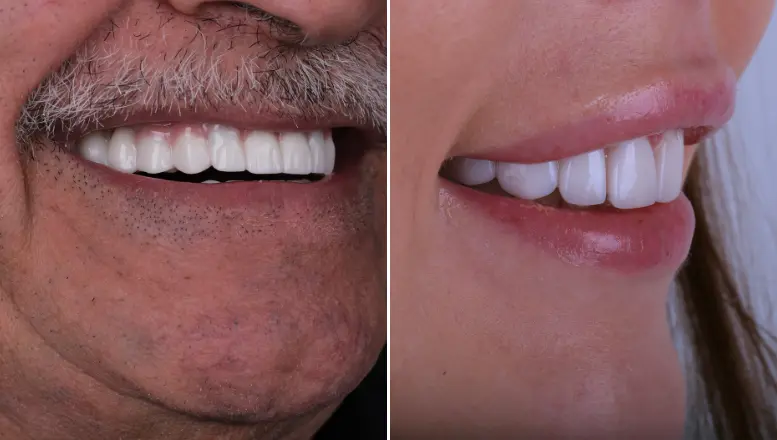
- Veneers Cost Factors: Veneer pricing typically ranges from 800 to 2,500 USD per tooth in Western countries, or 200 to 450 EUR per tooth in top medical tourism destinations like Turkey. Because veneers are classified as elective cosmetic procedures, they are rarely covered by standard dental insurance.
- Crowns Cost Factors: Premium ceramic or zirconia crowns range from 900 to 2,200 USD per tooth domestically, or 180 to 350 EUR per tooth abroad. Dental insurance policies frequently cover 50 percent or more of crown costs when medically necessary due to decay, fractures, or root canal therapy.
Comprehensive Clinical Comparison Matrix
| Clinical Parameter | Dental Porcelain Veneers | Full Dental Crowns (E-Max / Zirconia) |
| Coverage Area | Front (Facial) surface only | 360-degree full tooth coverage |
| Tooth Shaving Required | Minimal (0.3 to 0.7 mm) | Substantial (1.0 to 2.0 mm) |
| Primary Purpose | Cosmetic enhancement & minor shape fixes | Structural restoration & protection |
| Average Lifespan | 10 to 15 Years | 15 to 20+ Years |
| Gumline Margin Placement | Supragingival / at gumline | Subgingival / at gumline |
| Insurance Coverage | Rarely covered (Cosmetic elective) | Often covered (Medically necessary) |
| Best Suited For | Front teeth with intact structure | Broken, root-canaled, or decayed teeth |
Frequently Asked Questions (FAQ)
What are veneers vs crowns in simple terms?
In simple terms, a veneer is like a false fingernail for your tooth: a thin porcelain shell bonded only to the front surface to improve appearance. A crown is like a helmet or cap that fits over the entire shaved tooth to restore strength, structure, and chewing function.
Can a tooth with a veneer get a crown later in life?
Yes. If a veneered tooth experiences decay, structural trauma, or nerve issues years later, the veneer can easily be transitioned into a full crown. However, the process is one-way: once a tooth has been prepared for a crown, it can never have a veneer again because too much tooth structure has been removed.
Do veneers or crowns look more natural on front teeth?
Both restorations offer exceptional, lifelike aesthetics when crafted from high-grade lithium disilicate (E-Max) or layered porcelain. However, veneers generally offer slightly superior natural translucency because light passes through the porcelain and reflects off your natural inner tooth structure.
Is getting a veneer or crown painful?
No. The preparation and fitting processes for both veneers and crowns are performed under local anesthesia, ensuring you feel zero pain during the procedure. Patients may experience mild sensitivity to hot and cold liquids for a few days after preparation, which quickly subsides once the final restorations are permanently cemented.

 |
|