Skip to content

Bariatric surgery BMI requirements are usually the first thing people look up when they start thinking about weight loss surgery. Body mass index gives doctors a quick way to estimate how much excess weight a person carries, and most guidelines use it as an entry point for deciding who may be considered for surgery. It is only a starting figure, though, and it does not tell the whole story about your health.
This guide explains the BMI thresholds that are commonly used, how they differ between guidelines and populations, which health conditions can change the picture and what else is looked at besides your number. The information is general. Only a medical team that has examined you can say whether surgery is appropriate, which procedure might suit you and what risks apply to your own case.
Table of Contents
What Are Bariatric Surgery BMI Requirements?
Bariatric surgery covers operations that change the stomach or digestive tract to help people with obesity lose weight and improve related health problems. Because these are major procedures, medical societies have set criteria to help teams decide who is likely to benefit enough to justify the risks. BMI is the main measurable criterion in almost every set of guidelines.
Get Free Consultation
Have any questions? Leave your details and we'll get back to you shortly.
The requirements are guidance for clinicians, not rigid rules. A doctor may consider a person with a slightly lower BMI if there is a serious weight related illness, and may postpone surgery for someone who meets the number but has other concerns. This is why a consultation matters more than any calculator.
How BMI Is Calculated
BMI is your weight in kilograms divided by your height in metres squared. A person who weighs 110 kg and is 1.70 m tall has a BMI of about 38, because 110 divided by 2.89 is roughly 38. Online calculators do the same sum in seconds, and your doctor will confirm the figure with a proper measurement.
BMI has limits. It does not separate muscle from fat, it does not show where fat is stored and it can mislead in very muscular people, older adults and some ethnic groups. For that reason, clinicians treat it as one piece of information next to waist size, blood tests and medical history.
BMI Categories at a Glance
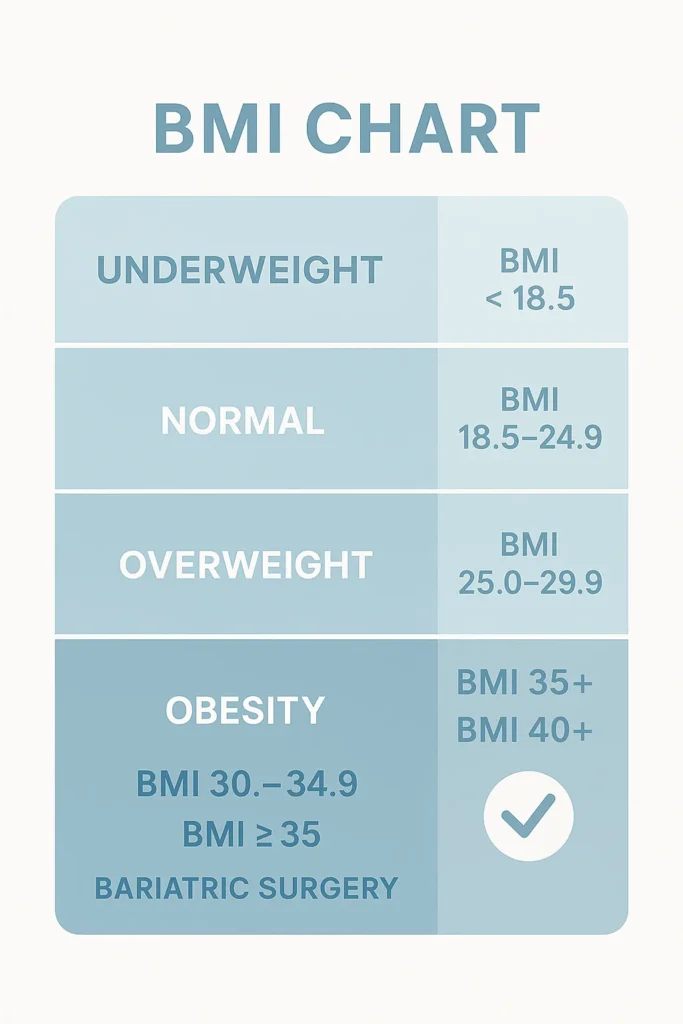
The table below shows the standard adult BMI ranges used by the World Health Organization and how they are commonly linked to surgical discussions. It is a simplified summary and not a decision tool.
| BMI range | Category | Typical relevance to surgery |
|---|---|---|
| Below 25 | Normal or lower | Surgery is not considered for weight loss |
| 25 to 29.9 | Overweight | Not usually considered, except in specific research or regional guidance |
| 30 to 34.9 | Obesity class 1 | Sometimes considered when metabolic disease is present |
| 35 to 39.9 | Obesity class 2 | Commonly considered, especially with related conditions |
| 40 and above | Obesity class 3 | Commonly considered after assessment |
Common BMI Thresholds in Guidelines

For many years, the standard teaching was that surgery could be considered at a BMI of 40 or above, or at 35 and above if a serious related condition such as type 2 diabetes, sleep apnoea or high blood pressure was present. This framework came from a consensus statement in the early 1990s and shaped practice for decades.
More recent guidance from international bariatric societies has widened the approach. It describes surgery as recommended for people with a BMI of 35 or more regardless of other conditions, and says it should be considered for people with a BMI between 30 and 34.9 who have metabolic disease. Some national health services still apply stricter rules, so the exact threshold you meet depends on the country, the insurer and the treating team.
Do Different Ethnic Groups Have Different BMI Cut Offs?
Yes, in some guidelines. Research has shown that people of Asian descent can develop type 2 diabetes and heart problems at lower BMI values than people of European descent. For this reason, recent guidance suggests lower thresholds in Asian populations, with surgery considered from roughly a BMI of 27.5 in people with metabolic disease.
These adjusted values are not universal, and they do not apply in the same way everywhere. If you belong to a group that has its own cut offs, ask your doctor which guideline is being used and why. A transparent answer is a good sign of a careful team.
Health Conditions That Can Support Eligibility
At the lower end of the BMI range, the presence of weight related illness often decides whether surgery is discussed. These conditions are commonly taken into account:
- Type 2 diabetes or prediabetes that is hard to control.
- Obstructive sleep apnoea.
- High blood pressure that needs several medicines.
- Fatty liver disease and related liver problems.
- Joint problems linked to excess weight, such as knee osteoarthritis.
- High cholesterol or other metabolic problems.
Having one of these conditions does not mean surgery is right for you. It means your doctor may look more closely at the balance between benefits and risks. In some cases, medical treatment or lifestyle programmes remain the better first step.
Other Requirements Beyond BMI
BMI is rarely the only requirement. Most teams also want to know that you understand the operation and can commit to the changes that follow. The assessment often covers several areas:
Medical history and current health, including heart, lung, liver and hormone problems that affect anaesthesia and recovery. Previous weight loss attempts, which are reviewed to understand what has and has not worked. Eating patterns and mental health, because conditions such as binge eating or untreated depression can affect results and safety. Habits such as smoking, alcohol use and drug use, which can raise surgical risk and slow healing.
You may also be asked to stop smoking before surgery, to follow a short pre operative diet and to attend nutrition or psychological sessions. These steps are not punishments. They help the team prepare your body for the operation and support the long term changes that make surgery worthwhile.
Age Limits and Special Situations
Most programmes treat adults between 18 and about 65, but this is not a fixed boundary. Older adults can be considered when they are otherwise fit and the expected benefit is clear, while adolescents may be considered only in specialised centres under strict criteria. Each case needs an individual assessment.
Other situations also need careful discussion. Women who plan a pregnancy are usually advised to wait until weight is stable after surgery. People with previous abdominal operations, severe reflux or serious heart or lung disease may need a different procedure or extra tests. Revision surgery after an earlier operation follows its own criteria.
Which Procedures Might Be Considered?
The choice of procedure depends on your BMI, health conditions, eating habits and preference, and it is made together with your surgeon. The most common options are sleeve gastrectomy, which reduces the size of the stomach, and gastric bypass, which reduces the stomach and changes the route food takes through the digestive tract. Some centres also offer other options, such as intragastric balloons for selected patients.
No single operation is best for everyone. A higher BMI, a history of reflux, diabetes or previous surgery can all change the recommendation. Ask your surgeon to explain why a procedure is proposed, what the alternatives are and what the known risks are.
What the Evaluation Process Usually Looks Like
Although every centre has its own routine, the path from first enquiry to surgery often follows a similar order:
- An initial consultation to review your weight history, health conditions and goals.
- Measurements and blood tests, sometimes with tests of the heart, lungs or stomach.
- A review by a dietitian and, where required, a psychologist or psychiatrist.
- A discussion of the procedure options, benefits, risks and the lifelong follow up they involve.
- Preparation for surgery, including any diet or lifestyle changes the team asks for.
The number of steps and the time they take vary. A thorough process may feel slow, but it is meant to protect you and improve the chances that the operation does what you hope for.
Risks and Limits to Understand
All surgery carries risk, and bariatric surgery is no exception. Possible problems include bleeding, infection, leaks, blood clots and complications linked to anaesthesia, as well as later issues such as vitamin and mineral deficiencies, reflux or weight regain. The level of risk depends on your health, the procedure and the experience of the team.
Surgery is also not a cure that works without effort. Long term results depend on eating habits, physical activity, supplements and regular check ups. Outcomes differ from person to person, and no clinic can promise a specific amount of weight loss or the end of a health condition.
Frequently Asked Questions
What BMI do I need to qualify for bariatric surgery?
Many guidelines consider surgery at a BMI of 35 or above, and some at 40 or above, while a BMI from 30 to 34.9 may be considered when metabolic disease is present. The exact threshold depends on the guideline, the country and your medical team.
Can I have bariatric surgery with a BMI under 35?
In some cases yes. Recent guidance allows surgery to be considered between BMI 30 and 34.9 for people with conditions such as type 2 diabetes, and lower values are used in some Asian populations. This needs a careful assessment by a specialist.
Is BMI the only factor that decides eligibility?
No. Doctors also look at your health conditions, previous weight loss attempts, mental health, habits and readiness for lifelong follow up. BMI opens the discussion but does not make the decision.
Do I need to lose weight before bariatric surgery?
Some teams ask for a short period of weight loss or a special diet before surgery to make the operation safer. Whether this applies to you is decided by your surgeon and dietitian.

 |