Skip to content
Undergoing lens replacement or refractive lens exchange is an incredibly successful therapeutic milestone, restoring sharp focus and clarity to millions of patients every year. However, as the human brain adjusts to a newly implanted artificial intraocular lens (IOL), some patients notice unexpected, transient visual anomalies in their field of vision. In premium ophthalmic medicine, these post-operative optical artifacts are classified as dysphotopsia.
At our clinic, we know that waking up after a successful procedure only to see unexpected reflections or dark shadows can cause immediate concern. Understanding what is dysphotopsia, identifying the structural differences between its manifestations, and knowing how your brain naturally adapts to these shifts are vital steps during your post-operative healing journey.
Below, we detail the physiological causes of these visual anomalies, review effective strategies for managing dysphotopsia after surgery, and answer the most common practical recovery questions.
Get Free Consultation
Have any questions? Leave your details and we'll get back to you shortly.
Table of Contents
What Is Dysphotopsia and Why Does It Happen?
To answer what is dysphotopsia, we must analyze how light waves refract through a synthetic medical material compared to the eye’s natural crystalline lens. When an artificial intraocular lens is surgically positioned within the eye’s capsular bag, light enters the pupil and hits the edge of the lens optics at a slightly altered angle.
Dysphotopsia after cataract surgery occurs when light rays reflect off the square edges of the synthetic implant or split across the diffractive rings of premium multi-focal lenses. This optical behavior generates unintended internal reflections or shadows on the retina, which the brain perceives as phantom shapes or dark obstructions.
What Are the Differences Between Positive and Negative Dysphotopsia?
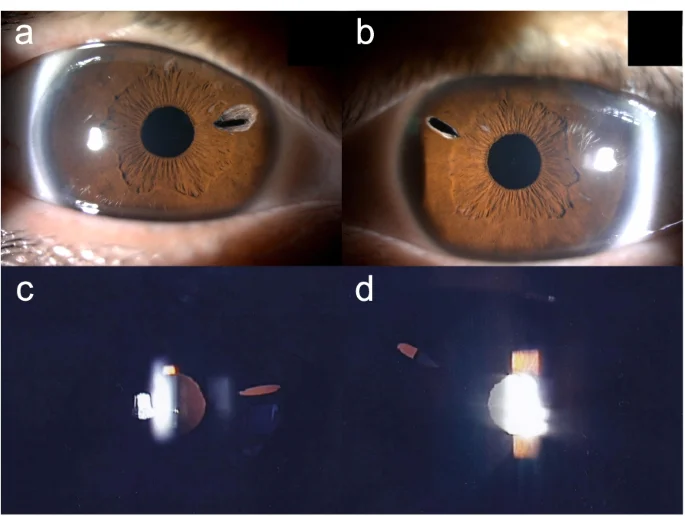
Ophthalmologists divide these post-operative optical anomalies into two distinct clinical presentations based on how the light interacts with the intraocular implant:
1. Positive Dysphotopsia
This type involves the perception of unwanted streaks, bright flashes, starbursts, or rings of light. Patients living with positive dysphotopsia typically notice these symptoms at night or in low-light environments when looking directly at bright light sources, like oncoming car headlights or streetlamps. It is caused by internal light reflections bouncing off the truncated, high-refractive-index edges of the synthetic lens implant.
2. Negative Dysphotopsia
Unlike the bright reflections of the positive type, negative dysphotopsia presents as a distinct, dark, crescent-shaped shadow or arc located at the far outer edge (the temporal periphery) of your visual field. This shadow can feel like blinking past the edge of a pair of eyeglasses or a small blind spot blocking your peripheral sight. Mechanically, it is caused by a small gap between where light rays pass through the lens and where light naturally bypasses the lens entirely, casting a narrow shadow across the peripheral retina.
How Is Dysphotopsia Managed in Presbyopia Correction?
Because premium lenses feature complex multi-focal or trifocal surfaces designed to correct reading vision, dysphotopsia management in presbyopia correction requires personalized pre-operative planning and careful post-operative evaluation.
During the initial recovery weeks, the brain must actively learn to process the overlapping light waves through a neurological healing phase called neuroadaptation. The visual cortex at the back of the brain works to naturally filter out the peripheral dark arcs or internal reflections, making them less noticeable over time. Ophthalmic surgeons use targeted clinical strategies to support this natural adjustment:
- Patience and Reassurance: The vast majority of visual anomalies resolve naturally within 3 to 6 months as neuroadaptation stabilizes.
- Miotics and Pupil Modulation: Administering mild prescription eye drops to constrict the pupil can stop light from hitting the square outer edge of the lens, instantly relieving peripheral shadows or glare.
- Premium Material Selection: Utilizing newer-generation lenses with rounded frosted edges or choosing a larger optic diameter can significantly lower the structural risk of casting shadows on the retina.
How Long Can Dysphotopsia Symptoms Last and How Do You Fix It?
A frequent concern among patients adjusting to their new vision is tracking the healing timeline and exploring permanent solutions if the symptoms do not fade.
How long do the symptoms last?
For most individuals, the shadows and reflections are temporary. They are most noticeable during the first 4 to 8 weeks following surgery. As the eye’s capsular bag heals, shrinks, and locks the lens into place, and as neuroadaptation progresses, the symptoms fade or disappear completely within six months for over 90% of patients.
How do you fix persistent cases?
If severe visual adjustments persist past a year and significantly impact your quality of life, a vitreoretinal or refractive specialist can deploy highly successful surgical revisions:
- Laser Capsulotomy: Using a YAG laser to modify a small portion of the capsular bag can alter light entry angles, relieving negative shadows.
- Piggyback Lens Implantation: Placing a second, ultra-thin secondary lens directly in front of the existing implant can change light refraction patterns, eliminating peripheral dark arcs.
- IOL Exchange: If non-invasive methods are insufficient, the surgeon can replace the lens with an implant made from a different material or featuring a different edge design.
Practical Recovery: When Can I Get My Eyes Wet in the Shower?

While managing your visual adaptation, adhering to strict physical hygiene rules is crucial for protecting the micro-incisions from infection. A vital question patients ask during their discharge consultation is: When can I get my eyes wet in the shower after cataract surgery?
POST-OP SHOWER SAFETY TIMELINE:
- Day 1-3: Wash from the neck down; use a damp cloth for the face (No tap water in eyes)
- Day 4-7: Careful showering permitted; avoid direct stream on face
- Week 2+: Normal showering; still avoid rubbing the eyes
You must strictly avoid getting direct tap water inside your operated eye for at least one full week following surgery. While you can take a shower from the neck down starting on the first post-operative day, washing your hair requires extreme care. Lean your head backward to keep shampoo and unsterile tap water from running down across your face and into the healing incisions, as tap water can carry harmful pathogens that increase the risk of endophthalmitis.
Frequently Asked Questions (FAQ)
What are the main symptoms of dysphotopsia?
The main symptoms are split into two categories: positive symptoms like seeing arcs of bright light, glare, and starbursts around night lights, and negative symptoms like a persistent dark, crescent-shaped shadow at the outer edge of your vision.
Is positive dysphotopsia a sign of an unsuccessful surgery?
No, it is a common physical interaction between light rays and the clear edges of a newly implanted lens. It is a normal part of the initial recovery process and indicates that your brain is still undergoing neuroadaptation.
How do specialists fix negative dysphotopsia permanently?
If the dark shadow does not clear naturally through neuroadaptation, specialists can fix it permanently using prescription eye drops to change pupil size, applying targeted YAG laser capsulotomy therapies, or performing a lens exchange with an implant that has a different edge structure.
Why is tap water dangerous during early recovery?
Unsterile tap water contains microscopic pathogens and bacteria. Because the tiny incisions made during surgery take several days to seal completely, getting tap water in your eye during the first week can introduce bacteria, leading to dangerous intraocular infections.

 |
|