Skip to content
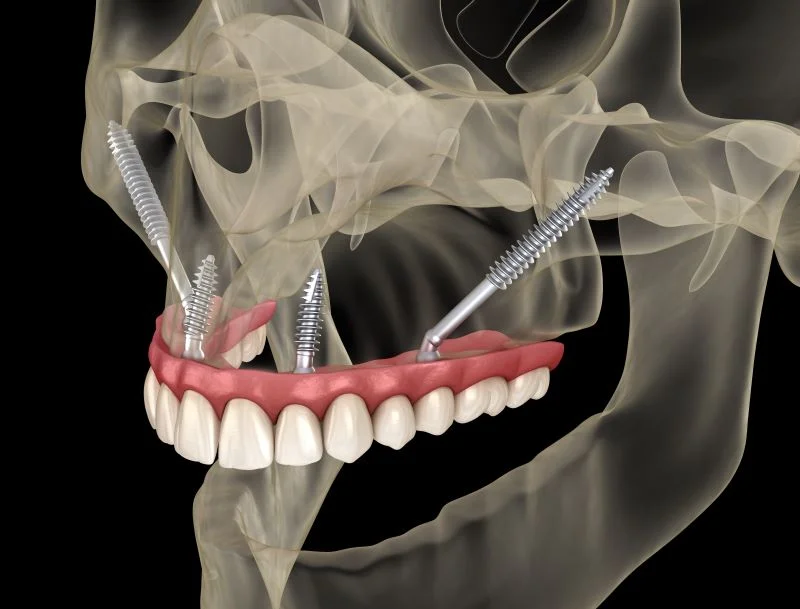
Severe tooth loss combined with long-term wear or advanced periodontal disease often leads to dramatic resorption (shrinking) of the maxillary (upper jaw) bone tissue. Historically, patients lacking sufficient bone density in the upper arch faced complex, multi-stage medical journeys involving major sinus lifts, painful bone grafts harvested from the hip or tibia, and over a year of waiting before a single dental implant could be placed. In modern implantology, patients suffering from extreme bone atrophy no longer have to undergo these grueling processes. Zygomatic implants provide a revolutionary, graftless surgical milestone that utilizes the dense structural frame of your facial bones to anchor a fully functional, permanent smile instantly.
For many international patients, understanding the mechanical differences between traditional dental implants and cheekbone-anchored configurations can feel overwhelming. Evaluating advanced protocols like quad placements, mapping out your recovery window, and selecting an accredited medical framework are essential steps to achieving a safe, permanent anatomical transformation. This comprehensive clinical guide breaks down the premier surgical pathways, analyzes international cost parameters, outlines potential side effects, and answers your most critical recovery questions.
Table of Contents
What Are Zygomatic Implants?
To appreciate the medical design behind this treatment, we must first answer a fundamental question: what are zygomatic implants exactly? Unlike standard dental implants that insert directly into the alveolar bone of the upper or lower jaw, zygomatic variants are extra-long, highly specialized biocompatible titanium fixtures. They range from 35mm to 55mm in length nearly three times the size of a standard implant.
Get Free Consultation
Have any questions? Leave your details and we'll get back to you shortly.
Instead of relying on the fragile, resorbed upper jawbone, these implants bypass the maxillary sinus entirely to anchor securely into the dense, stable cortical bone of the zygoma, which is anatomically known as your cheekbone.
What Are Zygomatic Implants Used For?
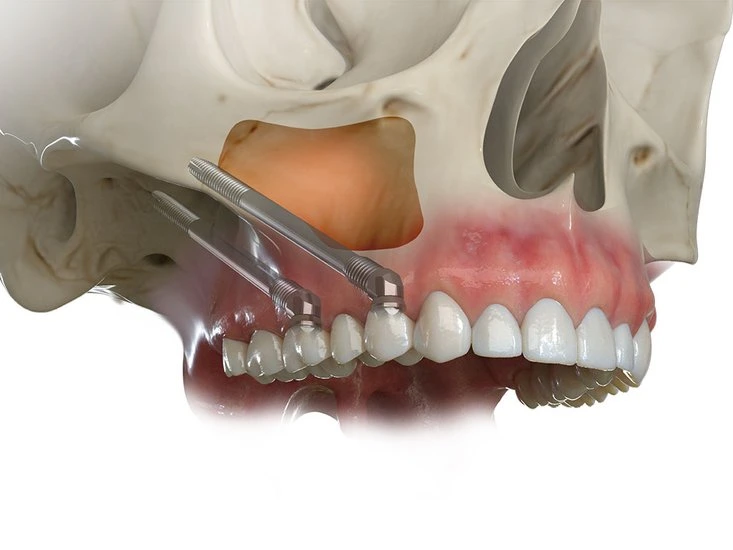
Understanding what are zygomatic implants used for highlights their problem-solving role in complex restorative dentistry. The primary medical indications include:
- Severe Maxillary Atrophy: Restoring teeth for patients who have lost all or most of their upper teeth, causing the upper jawbone to shrink over time.
- Failed Traditional Implant Overdentures: Providing a strong backup solution when standard All-on-4 or All-on-6 arches fail due to progressive bone loss.
- Genetic and Medical Conditions: Restoring oral function for individuals suffering from severe cleft palate deformities or tissue loss following tumor resections.
- Graftless Rehabilitation: Eliminating the need for painful, expensive bone grafting procedures for patients who want an immediate fixed smile.
What Is the Zygomatic Implants Procedure?
The clinical implementation of a zygomatic implants procedure is an advanced oral and maxillofacial intervention that requires specialized surgical training beyond standard dental schooling.
The standard zygomatic implants surgery timeline follows a strict safety protocol:
1. 3D Digital Diagnostics
The surgical team performs high-resolution Cone Beam Computed Tomography (CBCT) scans. Specialized dental software converts these scans into a 3D digital model, allowing the surgeon to map out the exact paths for the implants, keeping them safely away from vital facial nerves and the orbital cavities.
2. Surgical Anchorage
Under intravenous (IV) sedation or general anesthesia, the maxillofacial surgeon makes a precise incision in the upper gum tissue. Utilizing specialized surgical guides, the extra-long titanium rods are angled precisely through the alveolar ridge, bypassing the sinus cavity, and anchored into the solid cheekbone.
3. Immediate Fixed Loading
Once optimal structural torque (stability) is verified, special multi-unit abutments are attached. A customized, highly durable provisional acrylic bridge is then securely screwed onto the implants within 24 to 48 hours, providing an immediate fixed smile.
What Are Quad Zygomatic Implants?
When analyzing advanced surgical configurations, the density of your remaining bone determines the exact layout of the titanium pillars. If a patient retains moderate bone density in the front region of the upper jaw, surgeons typically combine two zygomatic implants in the back with two to four standard implants in the front.
However, when a patient suffers from absolute, total bone resorption across the entire upper arch, a highly advanced technique called quad zygomatic implants is required. In this complex setup, four specialized zygomatic implants are placed simultaneously two angled into the left cheekbone and two into the right cheekbone. This provides a rock-solid foundation that can support a full temporary arch without needing any upper jawbone support at all.
What to Expect: Zygomatic Implants Before and After
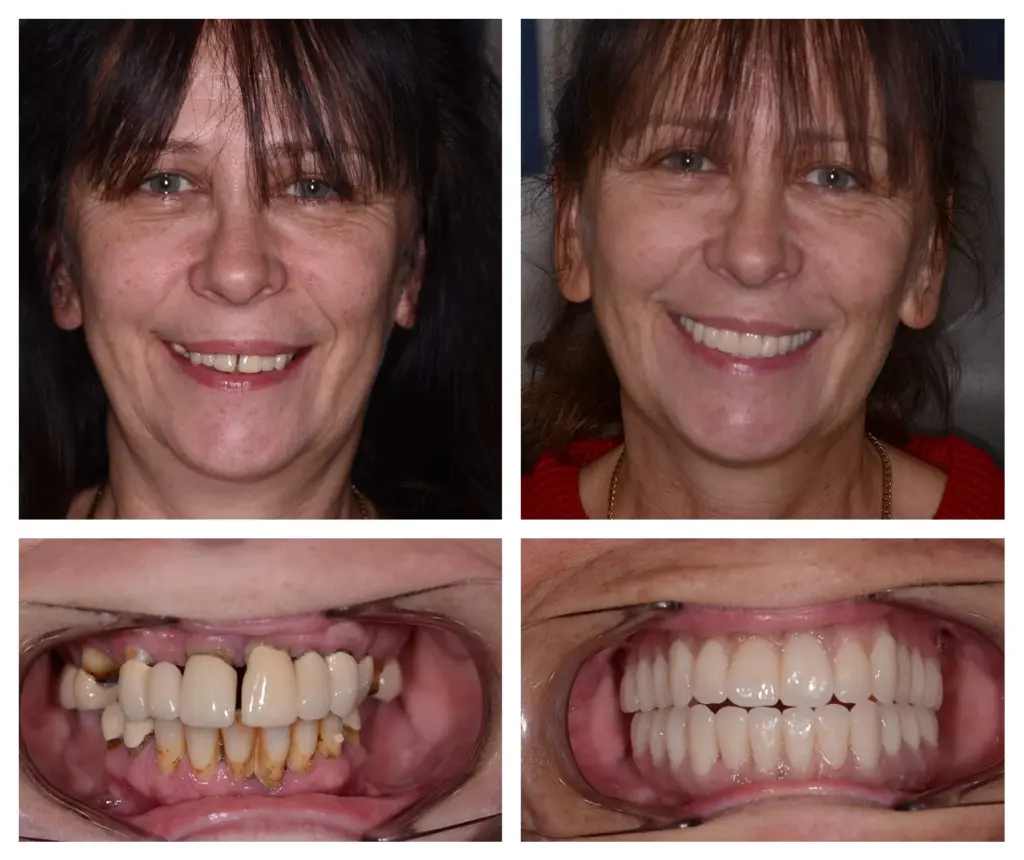
The profound transformation achieved through this treatment is clearly visible when examining a zygomatic implants before and after timeline. Before surgery, patients often present with severe facial sagging, collapsed lip dynamics, and an inability to chew solid food due to loose, failing dentures or extensive tooth loss.
Following the immediate loading phase, the “after” zygomatic implants results reveal an entirely revitalized facial structure. The permanent bridge restores natural lip support, eliminates the facial hollows associated with tooth loss, and provides a rock-solid bite force that functions exactly like organic teeth.
What Is the Zygomatic Implants Recovery Time?
Because this approach completely eliminates the need for bone grafting, the overall zygomatic implants recovery time is significantly faster than traditional reconstructive methods.
THE ZYGOMATIC POST-OP RECOVERY TIMELINE:
- Day 1-3: Peak swelling and localized bruising around the cheeks and lower eyes; manage with ice packs.
- Day 7-10: Initial soft tissue healing; surgical micro-sutures are safely removed or dissolve naturally.
- Month 1-3: Osseointegration phase; the titanium rods bond permanently with the dense cheekbone.
- Month 4-6: Complete tissue stabilization; your temporary bridge is replaced with your final titanium-reinforced prosthesis.
To guarantee a safe recovery and prevent early complications, patients must commit to a strict soft-food diet for the first 3 to 4 months. This soft diet ensures the implants remain completely stationary while they naturally fuse with the cheekbone matrix.
What Are the Potential Zygomatic Implants Side Effects?
Every advanced surgical intervention involves a careful balance of benefits and potential clinical risks. When analyzing potential zygomatic implants side effects and rare long-term complications, patients must be aware of:
- Sinus Congestion and Sinusitis: Because the long titanium fixture travels close to or through the borders of the sinus lining, temporary inflammation or post-operative sinus congestion can occur.
- Temporary Cheek Numbness: Minor nerve irritation during placement can cause temporary altered sensation in the mid-facial region, which usually resolves over a few weeks.
- Suborbital Bruising: Due to the cheekbone placement, localized bruising can develop underneath the lower eye region during the first few days.
- Prosthetic Bulkiness: Because the anchorage sits higher up, the palatal contour of the bridge may feel slightly thicker to your tongue during the first few weeks of speech adaptation.
How Long Do Zygomatic Implants Last?
A primary reason this treatment has become a global standard is its exceptional long-term reliability. If you are wondering how long do zygomatic implants last, clinical tracking data spanning over 20 years shows a success rate exceeding 95%.
Because the cortical bone of the cheekbone is exceptionally dense and does not suffer from the same age-related bone loss as the jawbone, zygomatic configurations routinely last a lifetime. Maintaining excellent oral hygiene and attending regular professional checkups are the only requirements to ensure your smile remains stable permanently.
Zygomatic Implants Cost and the Turkey Choice
The baseline zygomatic implants cost is objectively higher than standard dental implants due to the advanced surgical skills required, the specialized design of the titanium fixtures, and the need for IV sedation or general anesthesia. In the UK, USA, and Western Europe, a full upper arch restoration utilizing zygomatic pillars can range from £15,000 to £30,000 under private care frameworks.
This significant financial barrier is why getting zygomatic implants Turkey has become a premier global choice. But why is the zygomatic implants cost in Turkey more accessible?
Because of lower local operational overheads, favorable currency exchange dynamics, and a highly integrated medical tourism infrastructure supported by the government, top-tier maxillofacial centers in Turkey can provide identical FDA-approved premium implant brands (such as Nobel Biocare) and board-certified maxillofacial surgeons at a fraction of Western prices. These comprehensive international packages seamlessly combine advanced surgery, luxury hotel accommodation, private VIP transfers, and a full year of post-operative follow-up care into a single financial solution.
Comprehensive Structural Breakdown
| Restorative Metric | Zygomatic Dental Implants | Traditional All-on-4 Implants |
| Primary Anatomical Anchorage | Dense Cortical Bone of the Cheekbone | Alveolar Bone of the Upper/Lower Jaw |
| Average Fixture Length | 35mm to 55mm | 10mm to 15mm |
| Bone Grafting Required | No (100% Graftless Alternative) | Frequently required if bone loss is present |
| Average Surgical Duration | 1.5 to 3 Hours (Under IV Sedation) | 1 to 2 Hours |
| Suitability for Severe Atrophy | Maximum (Engineered for zero-bone cases) | Low to Moderate (Requires baseline bone) |
| Average Long-Term Success Rate | 95% to 98% over a 20-year horizon | 95% to 97% |
Frequently Asked Questions (FAQ)
Is zygomatic dental implant surgery painful?
No, the surgery itself is completely painless. The entire procedure is performed under deep intravenous sedation or general anesthesia, meaning you will be entirely relaxed and comfortable throughout the operation. Post-operative swelling and mild discomfort are easily managed with prescribed medications.
How soon after the surgery will I receive my fixed teeth?
You will typically receive your customized, fixed provisional teeth within 24 to 48 hours after surgery. This temporary bridge is securely screwed onto the implants, allowing you to smile, speak, and eat soft foods immediately while your gums heal.
Are cheekbone-anchored implants safe for long-term health?
Yes, they are exceptionally safe. Oculoplastic and maxillofacial data confirm that high-grade titanium is fully biocompatible, meaning your body accepts it naturally. The implants do not affect your sinuses or your natural facial expressions when placed by an expert surgeon.

 |
|